
Smart Human-Robot Collaboration for Maximized Waste Recovery
Recovering recyclable materials from post-consumer waste is fundamental to the circular economy, since it reduces reliance on primary resources and prevents valuable materials from being lost at disposal. Waste sorting—an essential step before recycling—has long relied on manual labor in large-scale Material Recovery Facilities (MRFs). AI and robotics are now reshaping this process: smart robotic sorters use computer vision to identify and classify items on conveyor belts, while robotic arms with specialized grippers pick and place them into designated bins.
Rising labor costs and workforce shortages are accelerating the shift toward robotic sorting. Yet despite gains in throughput and continuous operation, robots still make non-negligible errors in object classification and grasping, making human intervention necessary and resulting in mixed human-robot sorting lines.
In practice, however, humans and robots work independently rather than in coordination. Robots follow fixed, rigid picking rules while humans sort in parallel; coordination between them is essentially absent, and human oversight—where it exists—focuses on safety rather than adaptive task-sharing. The result is inefficient capacity allocation, imbalanced workloads, and lower overall performance, while the repetitive nature of sorting processes induces fatigue and gradually degrades human performance during a shift.
From parallel, independent work to teamwork.
PARTNER closes this coordination gap, uniting human and robot agents into a cohesive, high-performing team that maximizes material recovery and reuse. By assessing worker productivity and fatigue, it dynamically adjusts robot picking priorities—ensuring the most valuable materials are recovered even during peak loads or performance fluctuations.
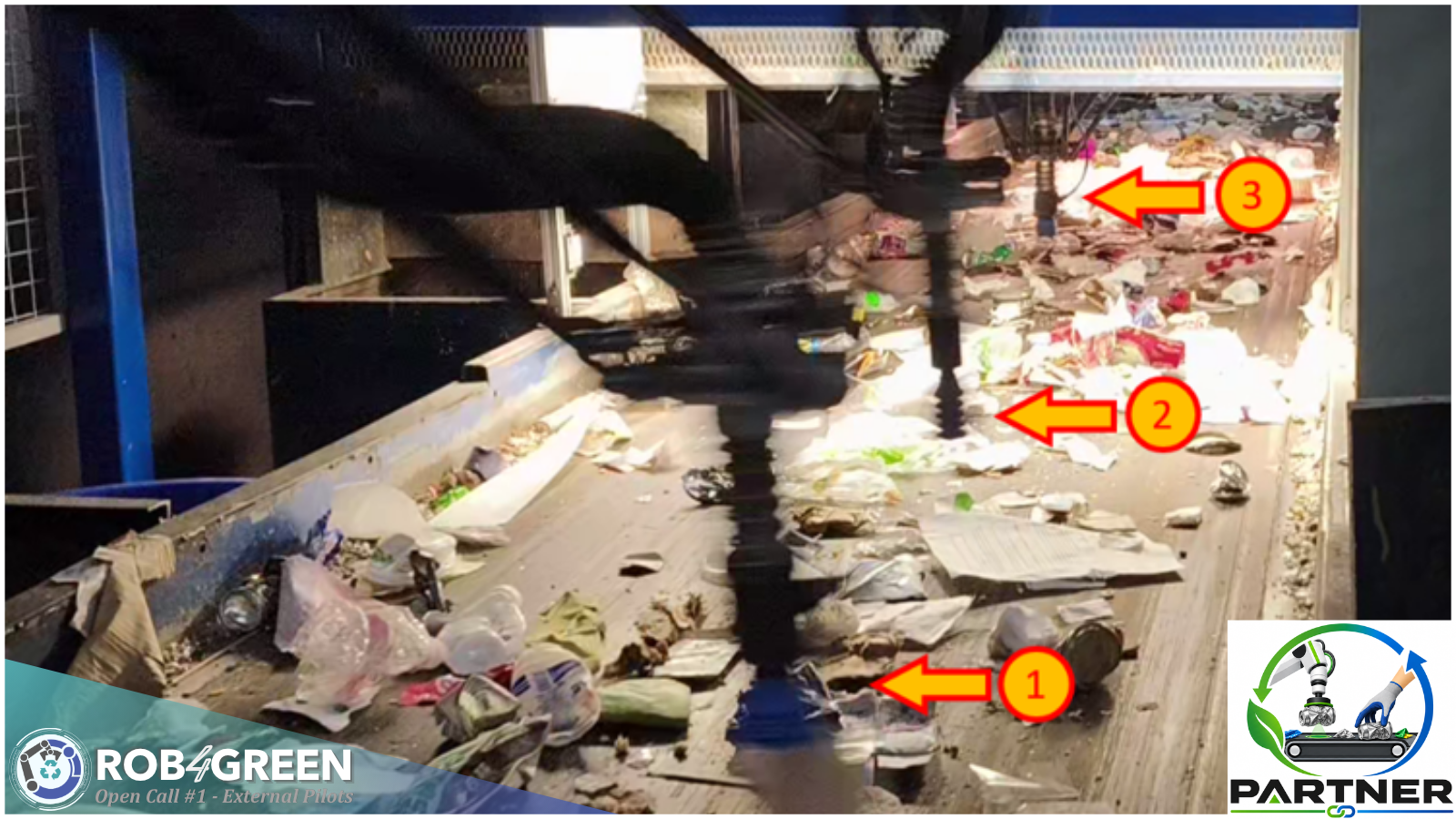
Turning solo players into a team: Real robots, real MRF, real coordination.
PARTNER focuses on optimally allocating picking capacity across all agents on the sorting line, dynamically coordinating robotic activity based on the evolving waste stream composition and the observed performance of human workers. By treating every agent on the conveyor as part of one coordinated team, a reinforcement learning policy—while directly controlling only robot actions—accounts for expected human behavior to boost joint material recovery. This marks a major step forward for the waste recovery sector, substantially improving MRF economic viability and turning waste treatment from a necessary but inefficient process into a high-performance, value-generating operation.
PARTNER will leverage two ROB4GREEN tools, the “Shopfloor Perception & Digitalization Suite (SDS)” and the “Skill-based dynamic Orchestrator with behavior trees (SBO)”, to implement cooperative multi-agent material sorting and showcase the advanced performance of the integrated system enabled by AI-driven multi-agent coordination. This gives ROB4GREEN's tools a rare opportunity for validation in a real industrial setting, integrating and coordinating three commercial robotic waste sorters. Such a setup is possible only because both the end-user and the robot provider participate jointly in the consortium, sharing the goal of turning standalone robots into coordinated team players.
PARTNER will be demonstrated at an operational MRF, showcasing seamless collaboration between human operators and three robotic systems that currently work independently. This intelligent coordination of human and robot sorting activity will represent a major advancement in MRF performance.
Dr. Maniadakis Michail
Dr. Maniadakis Michail has extensive experience applying AI and robotics to waste-sorting applications. He has coordinated two international projects that led to real-world deployments, demonstrating a strong track record in translating research into operational industrial systems. In PARTNER, he is responsible for AI-based waste sorting, the definition of evaluation scenarios and metrics, and the assessment of robotic accuracy and system performance.