
AI-enabled Robotics Reaches the Frontline of Infrastructure Repair
Crane rails in European ports and heavy industry carry some of the highest contact stresses in modern infrastructure. Rolling contact fatigue, plastic deformation, corrosion, and edge wear degrade these assets continuously, yet the repair methods used today have barely changed in decades. Maintenance crews still rely on manual arc welding performed at height, squeezed into shutdown windows of only a few hours. The result is low arc-on efficiency, high rework rates, and welders exposed to fumes, spatter, and hazardous working positions on elevated runway beams.
Factory-based robotic welding has matured impressively, but it depends on controlled environments and fixed part positioning. It simply does not transfer to unstructured jobsites. Previous attempts at mobile welding robotics have struggled with lightweight deployment and adaptation to site variability. At the same time, Europe faces a deepening shortage of structural welders, and the expertise of a retiring workforce is disappearing with them.
No commercial solution today combines automated inspection, adaptive AI-driven repair, and standards-compliant digital traceability in a single field-deployable platform. This is precisely the gap that the PAIRWELD pilot project, selected under ROB4GREEN Open Call 1, Challenge 1 on AI, Data and Robotics for Life Extension, is set to close.
What if a robot could do the dangerous part, and the best welder does the oversight?
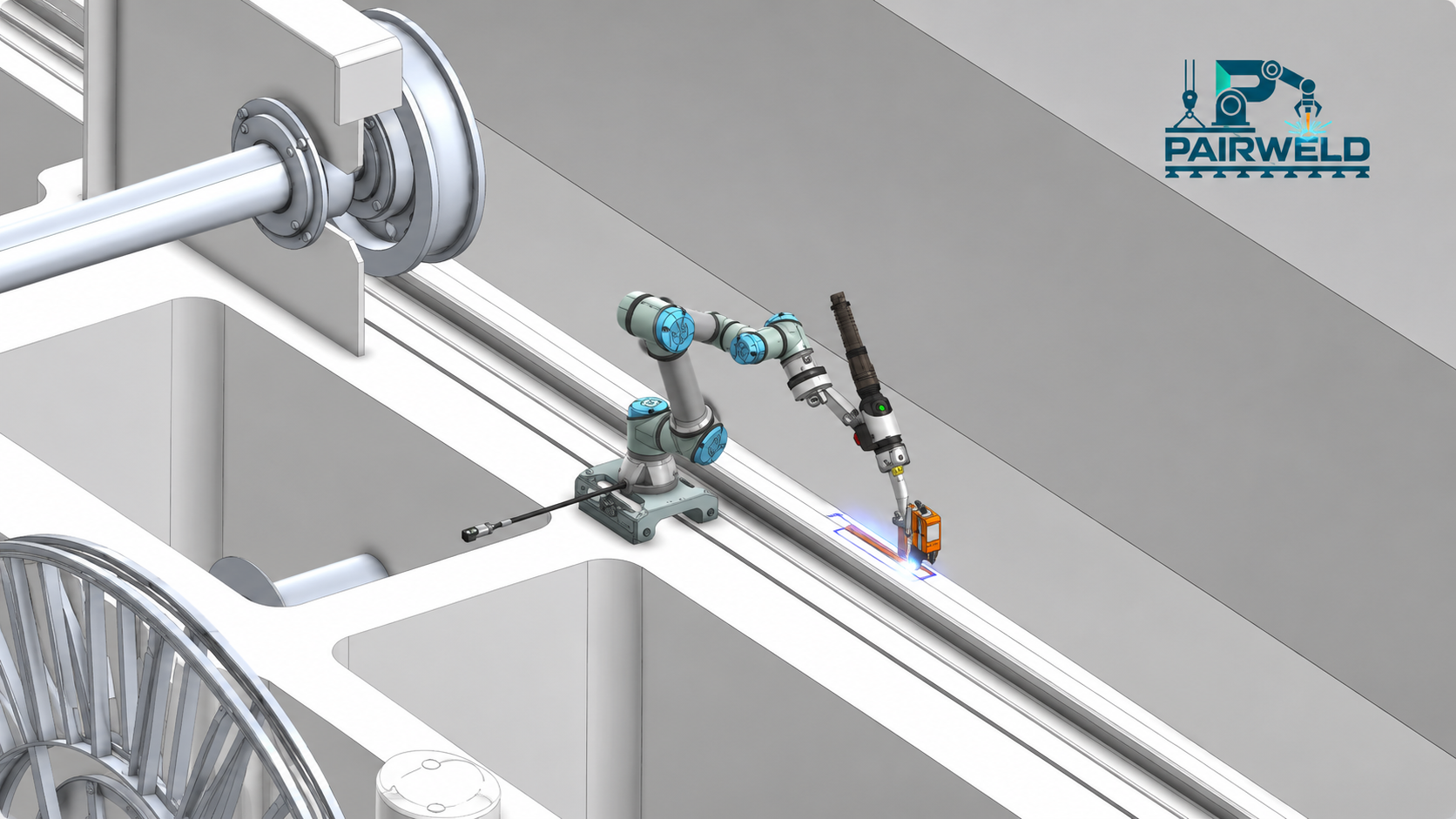
The project develops a collaborative robot designed for field deployment that perceives damaged rail geometry, reasons about the optimal repair strategy through physics-enriched AI, executes an additive welding repair, and verifies the outcome automatically. Every intervention is recorded in a Digital Product Passport, turning repair into a certifiable and repeatable service.
A single robotic workflow that scans, thinks, welds, and collects certification-worthy documentation. The system compresses four fragmented maintenance disciplines into one closed-loop process built for real industrial jobsites.
At the heart of the system sits RobTrack, the proprietary AI platform developed by 3D-Components AS and validated through multiple development projects. Unlike conventional data-driven models, RobTrack embeds process physics directly into its AI backbone, which allows it to generalize across the field variables that defeat ordinary automation, such as temperature shifts and material inconsistencies. Its process parameter predictions have demonstrated accuracy above 90%, and the architecture is protected by a couple of patents.
In operation, the collaborative robot follows a staged workflow. Multi-modal sensing first establishes an accurate picture of the damaged region, from the overall workspace down to fine surface detail. The AI layer then determines the welding strategy and generates adaptive tool paths tailored to the unique geometry of each job. A robotic Wire-Arc Additive Manufacturing (WAAM) process restores the lost material directly on the original component. After the repair, a cognitive inspection module classifies the weld condition and issues accept, rework, or reject verdicts against the governing welding standards.
Two ROB4GREEN tools anchor the integration. SAFE-RP provides safe trajectory generation for the collaborative robot in the constrained rail environment, while the Digital Product Passport (DPP) records every repair event and inspection result with FAIR-compliant metadata. This creates a digital thread from measurement to certification, enabling asset owners to move from age-based replacement schedules to evidence-based life extension decisions.
The targets are concrete. The pilot aims for a first-pass weld acceptance rate of at least 90% per ISO 5817 Level B, a 50% reduction in repair cycle time per meter, and automated defect classification at industrial-grade accuracy. Expected benefits include productivity gains of up to 200% compared to manual methods, greenhouse gas savings of up to 22% through precision deposition, and the transition of welders from hazardous torch work to safer supervisory roles.
From TRL4 to TRL7 in ten months. The consortium will demonstrate joining and repair on full-scale crane rail mock-ups governed by real welding procedures and standards.

Dr. Amin S. Azar, CEO of 3D-Components AS
Dr. Amin S. Azar is the founder and CEO of 3D-Components AS in Oslo, Norway, and coordinator of the PAIRWELD pilot. He holds a PhD from NTNU in deep-water subsea welding repair and brings over 20 years of experience in welding metallurgy, process optimization, and additive manufacturing. An expert team at 3DC drives the AI and robotics development, researchers at Mechatronics Innovation Lab (MIL) provide integration and validation support, and an experienced end-user grounds the project in real crane rail maintenance practice.