

From Algorithms to Action: Enabling Intelligent Robotics for Battery Remanufacturing
Industrial battery repurposing presents a unique challenge for automation: it is not only a physical manipulation problem, but also a decision-making problem under uncertainty. Unlike conventional manufacturing, second-life battery workflows require continuous interpretation of heterogeneous inputs—visual, electrical and contextual—to determine safe and optimal processing strategies.
Current approaches typically separate perception, planning and execution into loosely coupled systems, limiting adaptability and robustness when facing real-world variability. This fragmentation becomes critical in operations such as module classification, disassembly or reassembly, where decisions directly affect safety, performance and downstream value.
Within the ROB4GREEN FlexiBAT pilot, the focus shifts towards tightly integrated AI and robotics pipelines, where perception, reasoning and action are orchestrated as a unified system. The challenge lies in embedding intelligence not only at the algorithmic level, but across the full execution stack—from data acquisition to motion planning and task orchestration.
This requires developing modular yet interoperable components capable of handling uncertainty, enabling flexible task execution and ensuring safe human-robot collaboration. The objective is to move from reactive automation to context-aware robotic systems, capable of adapting their behaviour dynamically based on the condition and characteristics of each battery module.
How do robots decide what to do when every battery module is different?
In FlexiBAT, we address variability not by constraining it, but by embedding intelligence across the system. AI models, orchestration layers and motion planning modules work together to enable adaptive, safe and efficient robotic decision-making in battery remanufacturing.
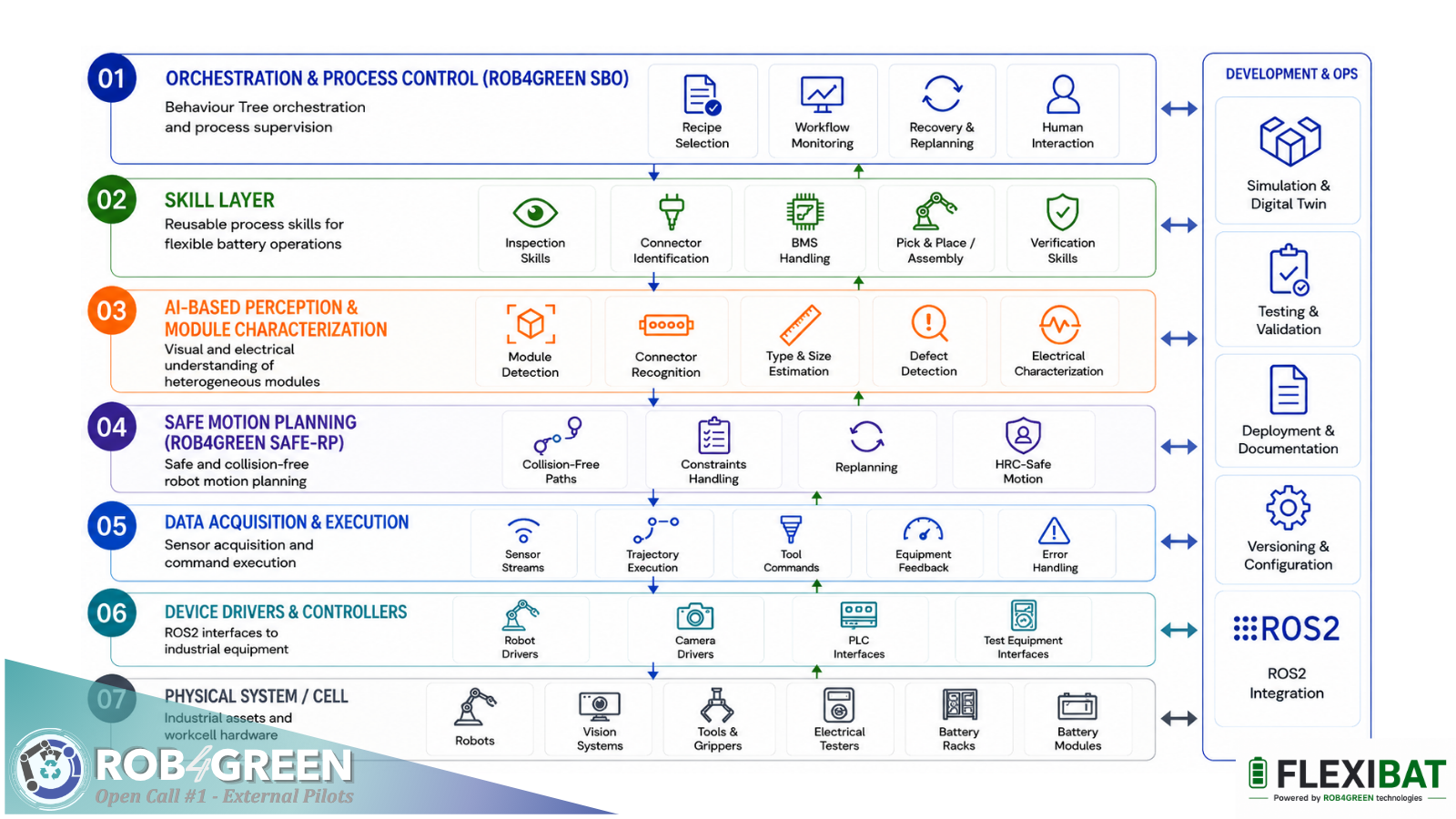
The FlexiBAT system is built around a multi-layered software and control architecture, where intelligence is distributed across perception, decision-making and execution modules.
At the perception level, AI models combine visual inspection and electrical characterization data to extract meaningful features from heterogeneous battery modules. These include defect detection, connector identification, type classification and state-of-health estimation. Rather than producing isolated outputs, these models contribute to a multi-criteria decision framework, enabling informed routing and processing strategies.
These perception outputs are encapsulated as ROS2-based modules, allowing seamless integration within the broader system. This modularity is key to ensuring scalability and reusability across different battery types and operational scenarios.
At the orchestration level, the Skill-Based Orchestrator (SBO) coordinates robotic actions using behaviour trees, enabling flexible sequencing and adaptation of tasks such as inspection, disassembly or assisted assembly. Each capability—whether AI-based inspection or robotic manipulation—is abstracted as a reusable “skill”, allowing dynamic reconfiguration of workflows depending on context.
Motion execution is handled through SAFE-RP, which ensures collision-free and human-aware trajectory planning in collaborative environments. This layer is critical for translating high-level decisions into safe physical actions, especially when interacting with uncertain or partially known environments.
From an integration perspective, these components are progressively combined into a unified system, where AI-driven perception informs orchestration, and orchestration drives safe robotic execution. The result is a tightly coupled pipeline capable of adapting to variability while maintaining performance and safety.
This approach enables not only improved efficiency and repeatability, but also lays the groundwork for intelligent, data-driven remanufacturing systems aligned with future industrial and regulatory requirements.
Towards intelligent robotic systems where perception, decision-making and motion are seamlessly integrated to handle variability, ensure safety and maximise performance in battery remanufacturing.

María Teresa Lázaro – ITA (Instituto Tecnológico de Aragón), Robotics R&D Lead
PhD in Systems Engineering and Computer Science - Robotics. Researcher specialised in robotics, AI and autonomous systems, with a focus on perception-driven manipulation, motion planning and system integration. Within ROB4GREEN, she leads the development and integration of AI modules, orchestration frameworks and safe robotic execution strategies.