
From Recycling by Weight to Recycling by Value
The easiest thing to lose in electronic waste is not metal — it is reuse value that no one has identified yet. The EU generates around 5 million tonnes of electrical and electronic waste each year, growing far faster than recycling capacity. Computers sit at the high-value end of that stream: a single machine holds critical raw materials worth EUR 15–45, while a working CPU, RAM module, GPU or power supply can be worth 10–50 times its raw-material content on the secondary market. Today’s recycling lines, however, are engineered for what they do well: safe, high-throughput material recovery. After limited manual sorting, most parts move on by weight or material class. Operators cannot see component condition, live market prices and extraction cost at once — so a CPU with real resale value follows the same route as an obsolete board. The problem is not that the line cannot recycle; it is that one capability is missing: judging, before a part is shredded, whether it is worth more intact than melted down. CIRCULAI, our pilot under ROB4GREEN Challenge #3 (Parts Harvesting), is built to add exactly that capability — and to prove it under real production conditions at SUEZ Feyzin.
Before a component is shredded, can the line ask: is it worth more intact than melted down?
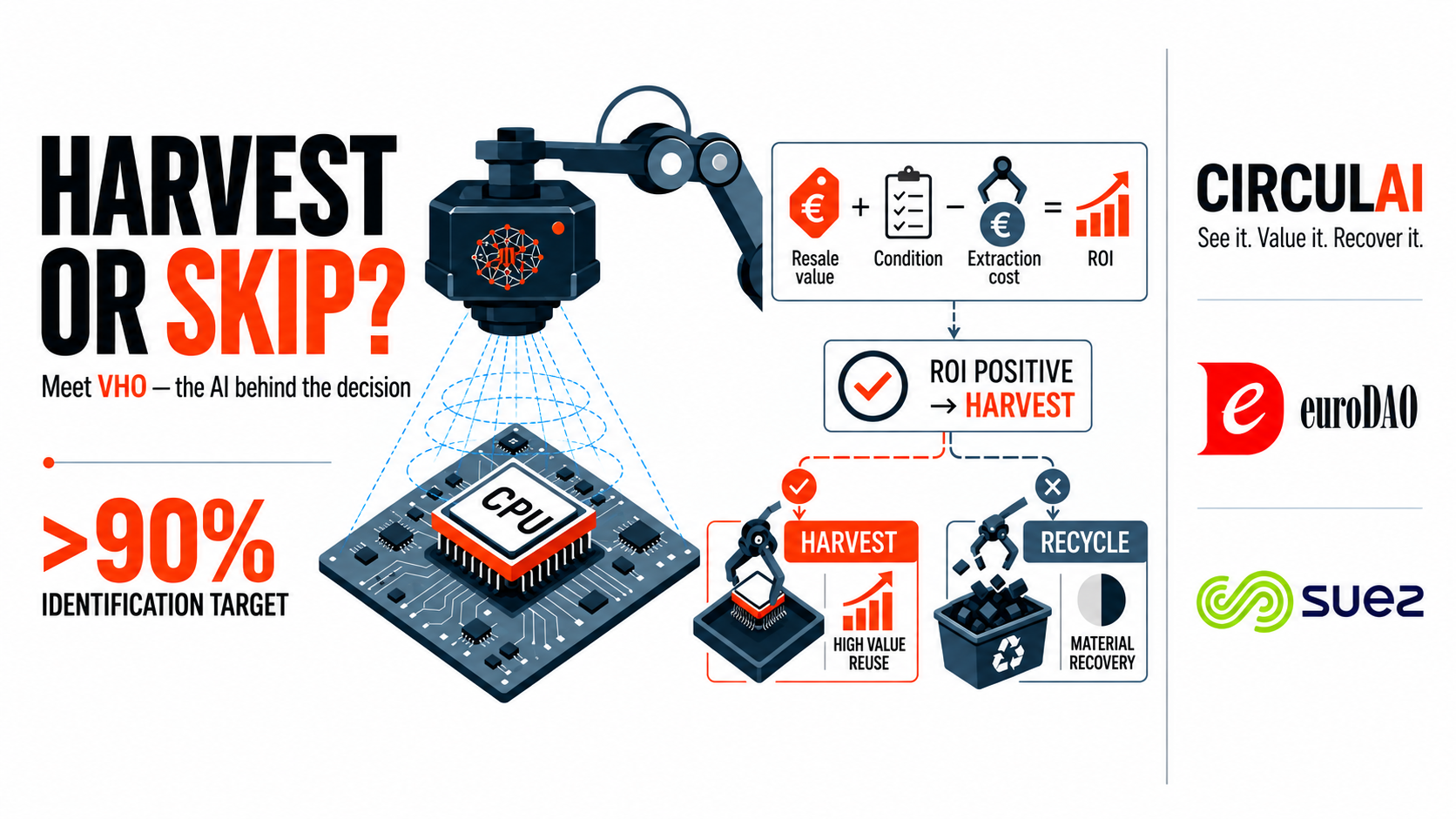
CIRCULAI adds a decision layer to the recycling line: see each component, estimate its value, decide whether to harvest, extract it robotically, and track the outcome. AI vision and the Digital Product Passport identify candidate high-value parts; an AI decision engine weighs resale value against extraction cost before any robot moves.
CIRCULAI is not about making robots dismantle more — it is about dismantling only what is worth it, giving every robot action an economic reason.
CIRCULAI’s first step is not disassembly — it is understanding the machine in front of it. An RGB-D camera and barcode/QR readers inspect each incoming computer, and the AI Agent cross-references what it sees against Bill-of-Materials data in the Digital Product Passport (DPP). Where legacy equipment has no manufacturer passport, the system builds a synthetic “bridge DPP” from vision and database scans, so today’s unlabelled waste can enter a data-driven process while staying compatible with the EU’s emerging ESPR framework. Seeing a part is half the job; valuing it is the other half. The Value Harvesting Orchestrator (VHO) — CIRCULAI’s value-recovery decision engine — combines secondary-market prices, component condition, and estimated extraction time and cost, and answers the question that matters on a production line: is this part worth extracting? Economically viable components join the selective-harvesting list; everything else continues into conventional material recovery, so no robot time is spent on low-value operations. RePlan, the ROB4GREEN planning block, turns the value-ranked list into an executable dismantling sequence, and collaborative robots (Aubo/Universal Robots, running on ROS 2) carry it out. Every detection, decision, extraction and destination is written back to the DPP, turning the passport from a passive record into a closed data loop — and giving operators an auditable trail of where every part went, ready for coming DPP and ESPR obligations. Validation uses real, mixed-brand computers at SUEZ’s WEEE facility in Feyzin, taking the system from TRL 4 to TRL 7. The pilot targets — to be verified, not yet achieved — include over 90% component identification accuracy, over 5% value-tiered recovery improvement versus the manual baseline, 100% DPP completeness on processed computers, at least 50% combined energy and material savings, and at least 10% GHG reduction.
From processing by weight to a traceable, ROI-based decision on every candidate part — proving on SUEZ’s live line what is worth harvesting, and why.
Dr. Lei Zhang
Dr. Lei Zhang is CEO and Research Director of euroDAO, and Project Coordinator and System Architect of the CIRCULAI pilot. He holds a PhD in Robotics from LIRMM and led euroDAO’s collaboration with SUEZ in the JARVIS/EARTH EU project at Feyzin. In CIRCULAI he integrates AI decision-making, the Digital Product Passport, RePlan and collaborative robots into one closed-loop system designed to be validated, replicated and deployed in real recycling environments.