
Why Semiconductor Harvesting Must Become Every Factory’s Standard
Walk down automotive assembly lines, and you will see how cars are rapidly changing: By 2030, electronics are expected to account for roughly 50% of a vehicle’s value.
For an automotive Tier 1 supplier like Valeo BRAIN, the relevance is even greater: printed circuit board assemblies (PCBAs) account for about 80% of the electronic systems we manufacture, and if you look even closer, just 3 to 4 core System-on-Chips (SoCs) represent up to 70% of the entire board's worth.
Yet, under traditional manufacturing practices, when a highly advanced board is rejected during end-of-line testing or returned under warranty, repair and rework are not always technically or economically feasible. In such cases, the board may ultimately be sent for material recycling, where the functional value of individual components is largely lost. As a result, potentially reusable high-value microchips can disappear into the scrap stream. In a world affected by supply-chain volatility and material constraints, treating these components only as “scrap” is a strategic blind spot.
It was more than time to change the rules of the game. Demanufacturing should not remain an isolated laboratory experiment; recovering these chips must become a standard, scalable, and automated industrial capability for electronics manufacturing worldwide.
From the lab to the shop floor, Veszprém gets concrete
Valeo’s high-volume production site in Veszprém, Hungary, brings this use case into a real industrial context.
But automating electronics demanufacturing is completely different from standard product assembly. It is a dual hands-on challenge:
1. Identification. Indeed, building systems that can instantly scan variable, heterogeneous circuit board designs, identify target chips, and determine real-time harvesting value.
2. And then, you need to desolder without destruction. Finding the exact sweet spot where a localized thermal profile liquefies solder joints, but keeps the application perfectly bounded so it does not damage the internal circuitry of the sensitive semiconductor we are trying to rescue.
To overcome this rigidity, a simple, blind automation loop won't cut it. It requires a flawless blend of advanced AI, real-time sensing, and highly adaptive collaborative robotics.
We Aim to Set a Universal Blueprint
This is exactly where the power of ROB4GREEN becomes our greatest asset. Without our technical interaction with Comau, bringing this process to life on the factory floor simply would not have worked.
While Valeo provides the real-world automotive use-case data, circuit topologies, and defect scenarios.Comau contributes its expertise in flexible pre-industrial robotic testbeds, while other ROB4GREEN partners support perception, decision-making, process planning, and system integration. Together, these capabilities are being combined into a modular environment able to cope with the variability of rejected PCBAs.
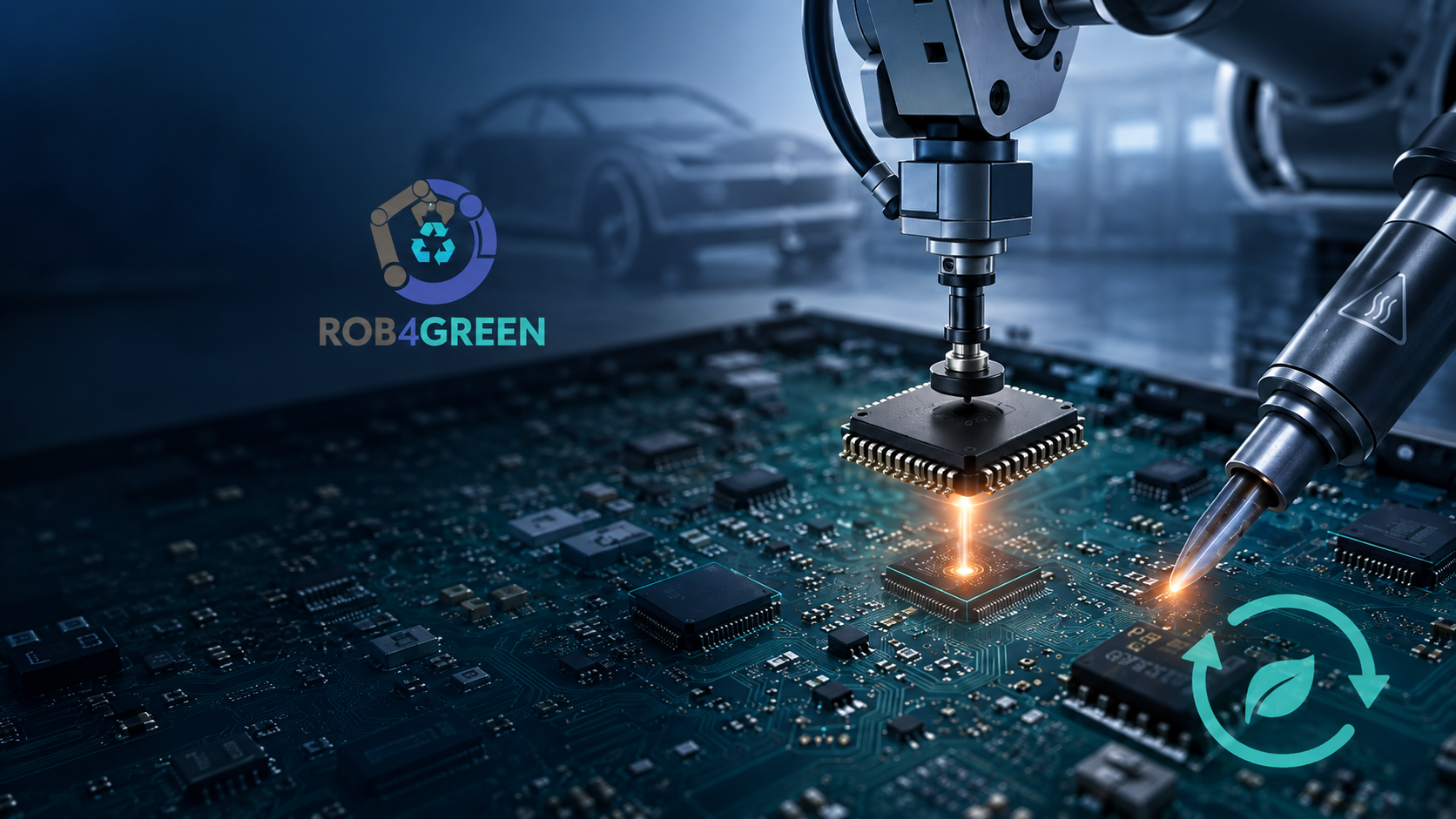
Instead of a heavy-handed industrial machine, the workstation utilizes a high-precision robotic manipulator capable of a surgical touch. By integrating advanced vision feedback and specialized end-effectors, the robot can handle sub-millimeter positioning changes between board batches. It precisely aligns the localized thermal desoldering modules, monitors variables in real-time, and uses delicate vacuum suction-cup grippers controlled by force feedback to safely lift the intact chips away.
By validating the concept first in pre-industrial testbeds and later under manufacturing conditions in Veszprém, ROB4GREEN aims to assess whether component harvesting can become technically robust, operationally practical, and economically viable at scale.
This pilot is just the beginning. Our intention is to foster a true demanufacturing mindset within each and every electronics factory across our footprint. To achieve this concretely, we must re-engineer our industrial strategy from the ground up: circular economy principles cannot stop at product development. No, we aim to integrate demanufacturing workflows not only into the initial design of the electronic parts themselves—making them inherently easier to disassemble—but also into the very layout of the shop floor. By embedding dedicated, automated harvesting nodes right alongside standard assembly equipment, we can close the value loop at the exact moment a defect occurs, transform our recovery efficiency, and set a transferable blueprint for the future of sustainable automotive electronics.

Marcell Benkő
Marcell is an Industrial Projects Manager at Valeo’s Veszprém site, with experience in automotive industrialization, process improvement, and cross-functional project coordination. In ROB4GREEN, he contributes as an industrial end-user representative for the electronics use case, helping translate factory needs and operational constraints into practical requirements for the AI-enabled robotic component harvesting solution. His work focuses on supporting the industrial validation of the concept and aligning project developments with real manufacturing conditions and future deployment opportunities within Valeo.