
Dissemination as Innovation: Building a Common Language Between Research and Industry
European Research and Innovation projects are designed to generate knowledge, develop technologies and contribute to long-term industrial and societal impact. However, impact does not happen automatically when a technical result is produced. It depends on how knowledge is shared, discussed, validated and translated into practical use.
This is particularly relevant for industrial projects working with Robotics, Artificial Intelligence and Circular Manufacturing. In these areas, the path from research results to industrial adoption is rarely linear. Technologies must operate in real environments, address variable products and materials, integrate with existing workflows and respond to the needs of operators, engineers and decision-makers.
For this reason, dissemination should not be understood only as visibility. Publishing news, presenting results and communicating progress are necessary activities, but they are not sufficient on their own. Industrial innovation also requires feedback, trust and a shared understanding of what has been achieved, what remains under development and what conditions are needed for future uptake.
In ROB4GREEN, dissemination is therefore closely linked with the project’s ambition to bring AI-driven collaborative robotics closer to greener dismantling, remanufacturing and recycling practices.
How can research results become useful before they are fully final?
In ROB4GREEN, dissemination can be understood as an innovation activity: a structured way to translate scientific progress into industrially relevant dialogue. It helps research teams, technology providers and industrial stakeholders exchange knowledge, clarify expectations and identify the practical requirements that advanced robotics and AI solutions must address.
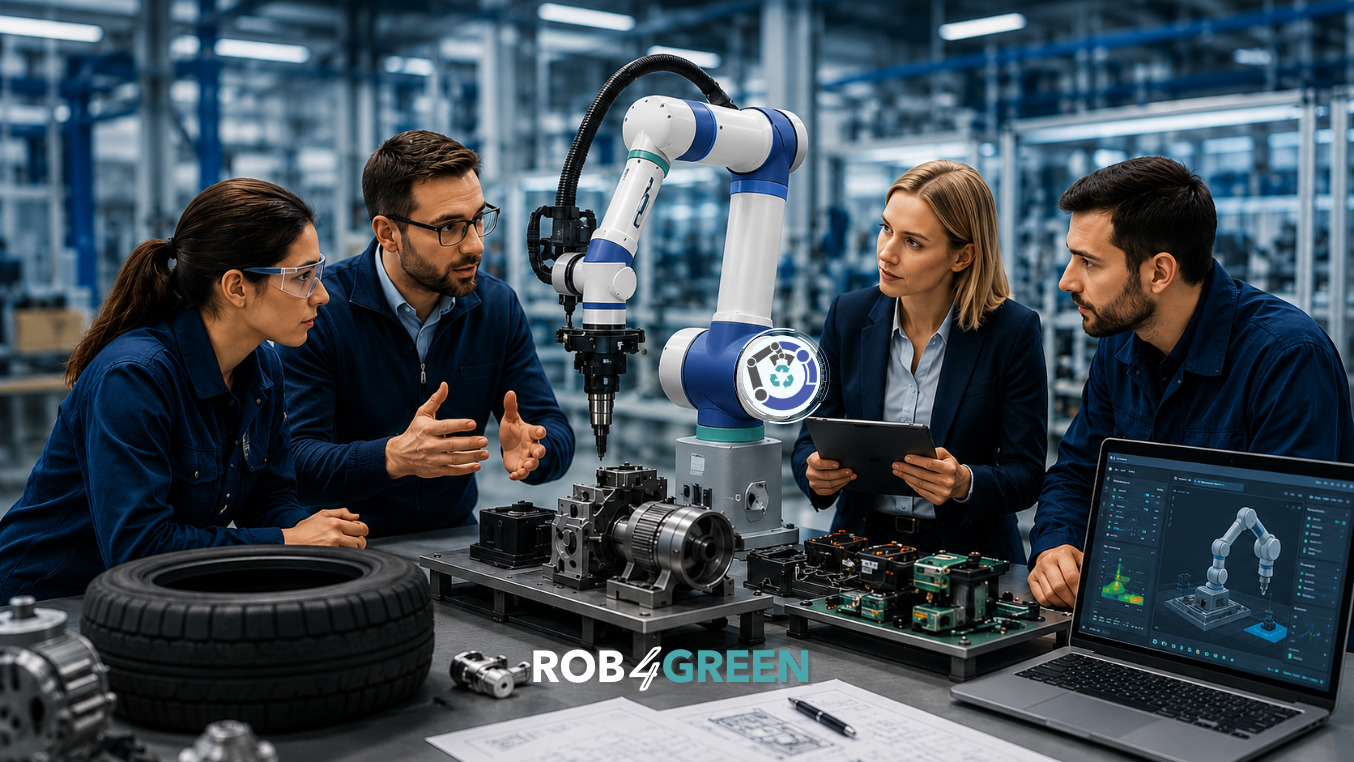
ROB4GREEN pilots connect AI, robotics and industrial feedback, helping research teams and industrial partners move from promising concepts to usable greener manufacturing solutions.
ROB4GREEN develops AI-driven collaborative robotic systems that can support the processing of products after their first life. The project addresses challenges such as perception, diagnostics, reasoning, adaptation, decision-making and flexible interaction between humans and robots.
These challenges are not only technical. They are also operational and organisational. A robotic system for remanufacturing or recycling must recognise variability, support safe and efficient processes, provide useful information to operators and fit within real industrial constraints. This requires continuous communication between those developing the technology and those expected to use or adopt it.
This is where piloting becomes essential.
ROB4GREEN pilot use cases focus on industrial scenarios such as wind turbine blade dismantling and recycling, inspection and remanufacturing of commercial heavy vehicle tyres, and harvesting or remanufacturing of electronic components. These pilots create the space where technologies can be tested against real requirements, and where industrial feedback can inform further development.
For TF-CC, this process is closely aligned with the Teaching Factory approach. The objective is not simply to communicate project outputs, but to enable the knowledge exchange between academia and industry. Researchers bring scientific methods, models and technological concepts. Industrial partners bring practical knowledge, process constraints, user needs and validation conditions. When these perspectives meet, dissemination becomes a two-way process.
This balanced approach is important for EU-funded Research and Innovation projects. Communication should be clear and accessible, but not promotional in a commercial sense. It should present progress with confidence, while remaining transparent about challenges, validation steps and remaining limitations. In this way, dissemination helps build credibility and supports informed engagement from industry.
Effective dissemination is not only about making a project visible. It is about making innovation understandable, discussable and usable. In this sense, dissemination is not the final step of innovation. It is part of how innovation is built. For projects such as ROB4GREEN, this means creating a common language between research and industry. It means using pilots, workshops, demonstrations and stakeholder feedback to connect technological development with industrial reality. It also means supporting people and skills, so that new AI and robotics solutions can be understood, assessed and adopted responsibly.
Grounded dissemination turns pilot evidence into shared understanding, supporting trust, feedback and future uptake across industrial value chains in Europe and beyond.

Panagiotis Aivaliotis
Executive Director of Teaching Factory Competence Center (TF-CC)
Panagiotis focuses on industry–academia collaboration, innovation ecosystems and knowledge transfer, supporting the adoption of advanced manufacturing technologies through the Teaching Factory approach.