
The AI Boom Is Here. But Should Your Factory Depend on Someone Else’s Cloud?
AI is moving from experimentation to everyday work. Companies are using Large Language Models to speed up writing, software development, knowledge retrieval, customer support and decision-making. The productivity gains are real, and manufacturing cannot ignore them. A factory that can use AI to support operators, interpret manuals, assist robotic systems or coordinate complex workflows may gain a significant advantage over one that relies only on traditional interfaces and manual procedures.

But there is another side to the story. Much of today’s AI adoption depends on external API providers. Companies build workflows around current token prices, model behaviour, rate limits and service availability, assuming that these conditions will remain stable. In reality, they may change. Prices can rise, limits can tighten, models can be replaced, outputs can degrade, and services can become unavailable at the wrong moment.

For a factory, this is not a minor inconvenience. If AI becomes part of the production workflow, then cloud dependency becomes an operational risk. The challenge is not simply to adopt AI quickly. The challenge is to adopt it in a way that protects data, controls costs, supports resilience and avoids unnecessary computational waste.
“What is riskier: depending on someone else’s AI prices, limits and uptime, or being left behind by companies that do?”
Luckily, there is a third path between ignoring AI and blindly depending on cloud APIs: locally hosted AI. As open-weight models rapidly improve, the gap with frontier systems is becoming small enough for many industrial tasks. Manufacturing does not always need the largest model available. It needs reliable, well-integrated AI workflows that can run close to the factory floor.
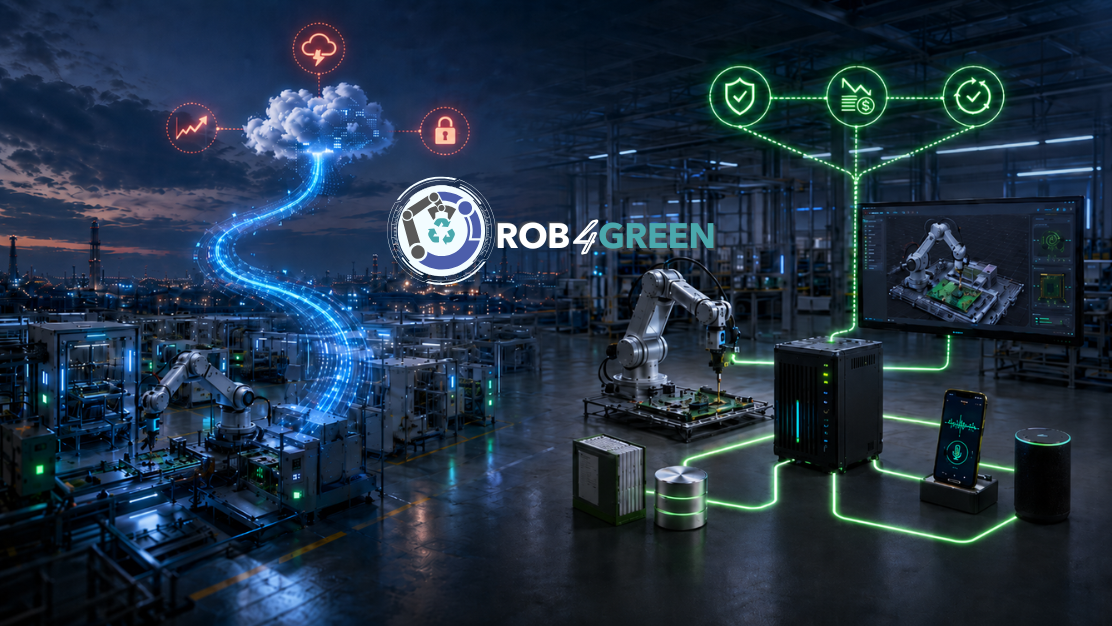
Locally hosted AI steps in: Rob4Green explores optimized LLM-based workflows for smarter, safer and greener robotic remanufacturing workcells.
In Rob4Green, locally hosted AI is not treated as a chatbot added on top of the system. It is explored as a way to make robotic remanufacturing workcells easier to use, easier to adapt and less dependent on external AI services.

One part of this work focuses on the interaction between the operator and the robotic system. AI agents can help bridge this gap through speech-to-text and text-to-speech interfaces that run on lightweight edge devices, with smartphone-class hardware already being suitable for parts of the voice interface. Instead of relying only on screens, buttons, or specialist software tools, the operator can communicate with the system in a more natural way.

Larger locally hosted models can then run on high-end consumer workstations inside the factory. These models are used in more demanding workflows, where the agent needs to interpret instructions, reason over process context or support decision-making. The key point is that the model is not left to guess. It is connected to the digital twin and to updated workcell information, so its responses are grounded in the actual state of the process.

Retrieval-Augmented Generation pipelines add another layer of value. Proprietary manuals, process databases and technical documentation can be searched by locally hosted LLMs, giving operators fast access to process details and tolerance-related information. This can reduce mistakes and speed up decision-making, while keeping sensitive company knowledge inside the factory network.

Rob4Green also explores how robot control frameworks can be linked to self-hosted LLM-based interpreter agents. This allows operators to command complex robotic systems through natural language, opening capabilities that would normally require robotics expertise or specialized programming knowledge.

The benefit is not only convenience. Self-hosted AI gives manufacturers greater control over their data, costs, and system availability. It also supports a more energy-conscious approach, since not every request needs to be sent to the largest available model. Instead, each workflow can use the smallest reliable model that is suitable for the task. For factories that start developing this capability early, locally hosted AI can become a strategic advantage, rather than a forced response to future cloud limitations.
The future advantage may belong to factories that learn to host, control and optimize their own industrial AI workflows.

Nikolaos Theodoropoulos, Senior Robotics R&D Engineer, LMS, University of Patras.
Nikolaos Theodoropoulos is a Senior Robotics R&D Engineer at the Laboratory for Manufacturing Systems and Automation (LMS). He holds a Diploma in Electrical and Computer Engineering, with a strong background in software engineering, computer science, control systems, and industrial automation. His work focuses on the design and implementation of AI-enabled robotic systems for manufacturing, including digital twins, computer vision, robotic control, deep reinforcement learning, optimization algorithms, and software architectures for reconfigurable automation. He has contributed to multiple research and industrial demonstrators and regularly disseminates his work through scientific publications.