

Scaling Circular Manufacturing: Comau’s Role in Advancing AI-Driven Robotics within ROB4GREEN
The transition toward circular manufacturing is pushing industries to rethink how complex products—such as tyres and composite components—are repaired, reused, or recycled. Current approaches remain largely manual, fragmented, and difficult to scale, especially when dealing with variability in materials, geometries, and defect conditions. These limitations result in inconsistent quality, reduced efficiency, and safety concerns for operators, while also constraining the recovery of valuable materials.
Within this context, the ROB4GREEN European Funded Project addresses a critical gap: the lack of integrated, flexible, and intelligent robotic solutions capable of operating in real industrial environments while adapting to variability. Traditional automation systems are often rigid and require highly structured conditions, making them unsuitable for circular processes such as repair or disassembly.
Comau’s role in ROB4GREEN focuses on bridging this gap by designing and validating pre-industrial robotic testbeds that combine AI, data, and advanced robotics. By enabling scalable and modular automation architectures, Comau contributes to transforming pilot applications into deployable industrial solutions. This approach supports a broader vision: accelerating the adoption of sustainable, data-driven manufacturing systems that can operate efficiently at scale while maintaining flexibility.
“Can robotics and AI unlock scalable circular manufacturing for complex, variable industrial processes?”
Comau enables flexible robotic testbeds that combine AI, data, and automation to scale circular manufacturing processes from pilot validation to real industrial deployment.
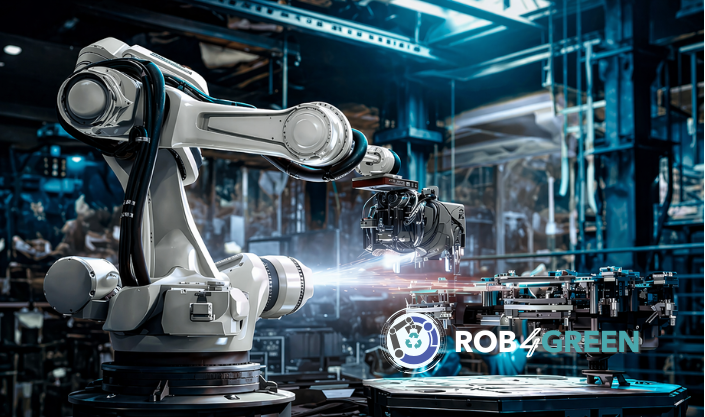
Within ROB4GREEN, Comau plays a central role in the design, development, and integration of pre-industrial testbeds under WP6, aimed at validating AI, data, and robotic applications in large-scale pilots. These testbeds act as controlled environments where enabling technologies are integrated, tested, and refined before industrial deployment. From a technical perspective, the system architecture combines robotic manipulators with specialized end-effectors, such as grippers and skiving tools, designed to handle complex and variable components. For example, in the tyre repair use case, robotic cells are configured to perform automated skiving and filling operations. Different process configurations are evaluated, including robot-guided manipulation versus fixed-tool setups, to optimize reachability, repeatability, and process efficiency.
Sensor integration is a key element: RFID detection systems, distance sensing, and vision-based feedback enable the robot to identify defects, adapt to positioning variability, and ensure process accuracy. These sensing capabilities feed data into higher-level control systems, where AI algorithms can support decision-making, such as defect localization or process parameter adjustment. The testbeds are also designed to integrate modules developed across other project work packages, ensuring interoperability within a unified digital architecture. This includes the progressive validation of system-level integration, from hardware acquisition and software development to full testbed deployment and on-site testing.
Comau’s vision is to move beyond isolated automation cells toward interconnected, modular, and scalable robotic ecosystems. By validating these solutions in pre-industrial environments, the project reduces the gap between research and real-world application, enabling faster adoption of circular manufacturing processes that are efficient, safe, and economically viable.
Integrated robotic testbeds improve process repeatability and scalability, enabling safer operations and paving the way for efficient, large-scale circular manufacturing adoption.

Pietro Alberto Cultrona, Comau SpA
Pietro Alberto Cultrona, Comau SpA, Safety Engineer. Pietro is a Safety Engineer with more than 20 years of experience in COMAU, focusing on industrial automation from design to commissioning, with a strong background in Industry 4.0 and predictive maintenance.
Thanks to his expertise, Pietro will ensure that the use case developments achieve the proper industrialization standards, while keeping a close eye on safety requirements.