

Vision-Guided Robotic Skills
for Autonomous PCBA Desoldering
Every year, the world generates a staggering 62 million tonnes of electronic waste (Global E-waste Statistics), a number that continues to climb at an alarming rate. Within this mounting pile of discarded electronics lie highly valuable components; in fact, the price of a single component can sometimes exceed €1,000. Currently, the predominant approach to recovering these components is manual PCB desoldering which is highly labor-intensive, inefficient, and simply not scalable to meet the demands of a true circular economy. This bottleneck results in immense loss of reusable materials and massive untapped cost savings.
In the European Horizon project ROB4GREEN one of the targets is on this critical gap by transitioning from rigid, manual dismantling to intelligent, flexible automation. To achieve cost-effective, large-scale component harvesting, the industry needs a solution capable of dynamically adapting to highly variable PCB layouts. By developing a fully autonomous, vision-guided robotic system for PCB component desoldering, we aim to improve e-waste management, ensuring that valuable electronics are efficiently recovered and kept out of landfills.
“How can we transform labor-intensive e-waste recycling into a scalable, automated component harvesting process?”
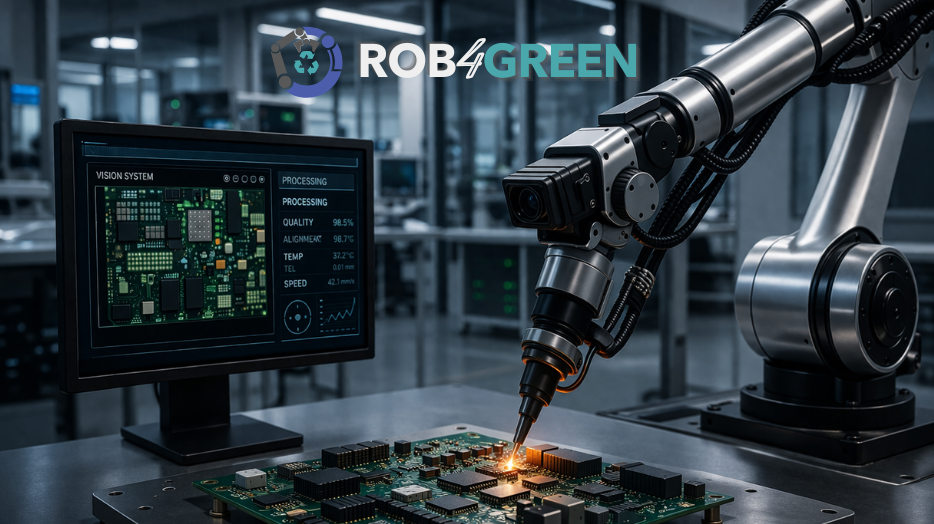
Our solution is a smart robotic desoldering tool that utilizes vision-guided robotic skills to automatically detect, heat, and remove specific components from printed circuit board assemblies (PCBAs). It relies on a skill-based behavior tree orchestrator to dynamically adapt to variable board layouts and orientations.
ROB4GREEN’s vision-guided robotic system aims to enable fully autonomous, high-precision component recovery, unlocking a scalable pathway for the circular economy.
At the core of our approach is a smart robotic desoldering tool equipped with a multi-modal sensor suite. The hardware setup includes a calibrated RGB camera, an infrared (IR) thermal unit, and a specialized gripper mounted directly on the robot flange. The visual system performs accurate PCB pose estimation under all rotations, enabling the robot to identify and locate target components based simply on a component placement file. Once a component is targeted, the thermal unit monitors the heating process in real-time to prevent any heat damage to the valuable parts. The entire architecture is integrated using ROS2.
A key driver behind the system's flexibility is its integration with the SIMROP framework. Developed by Flanders Make (FM), SIMROP is a powerful orchestration framework built on behaviortree.cpp. It acts as the central intelligence of the operation, containing a vast library of plugins for various robotic skills such as camera interfacing, advanced robot control, motion planning, and manipulation tasks like screwing and unscrewing. By leveraging SIMROP's skill-based behavior trees, our desoldering system can dynamically chain these robotic skills together to adapt seamlessly to unpredictable e-waste scenarios without requiring manual reprogramming.
The expected benefits of this automated approach are substantial. From an efficiency standpoint, the system boasts a cycle time of just 4 seconds per component in production, capable of processing up to 15 components per minute. It achieves high-precision manipulation with 1-2 mm picking accuracy. Ultimately, this leads to scalable, cost-effective material recovery.
Our autonomous desoldering robot is aimed to achieve 1-2 mm picking accuracy and
rapid cycle times of just 4 seconds per component, maximizing valuable material recovery.