

Smarter Decisions for a Greener Future: Intelligent Decision-Making in Sustainable Manufacturing
In pursuit of sustainable manufacturing, decision-making is often touted as a cornerstone of success. Yet, the reality within many organizations reveals that decision processes remain heavily dependent on tacit expert knowledge or extensive procedural manuals. While these traditional approaches have served as a solid foundation, they introduce significant challenges that hinder agility and scalability.

The reliance on tacit knowledge means that expertise is locked in the minds of seasoned professionals, making it difficult to transfer effectively. Because technical manuals and standard operating procedures are highly detailed and complex, it takes new employees a long training period to become fully operational.  This creates a bottleneck in onboarding and slows down operational responsiveness. Furthermore, the decision-making process is rarely explicit or transparent, leaving room for inconsistency and errors.

Adding to the complexity, sustainable manufacturing decisions often involve numerous interdependent rules and constraints, ranging from resource optimization and energy efficiency to compliance with environmental and product standards. Navigating this intricate web without structured decision support systems is not only time-consuming but also prone to suboptimal outcomes.
“What if manufacturers could augment manual, expert-driven processes with AI-powered systems that improve decision transparency?”
Current industry practices lack formalized, intelligent decision support frameworks that can make complex, rule-based decisions explicit, scalable, and adaptive. The challenge lies in supporting knowledge-heavy, manual-driven processes with data-driven, AI-enabled systems that reduce training time, enhance auditability and consistency, and handle complexity with precision, without compromising on product quality and employee well-being.
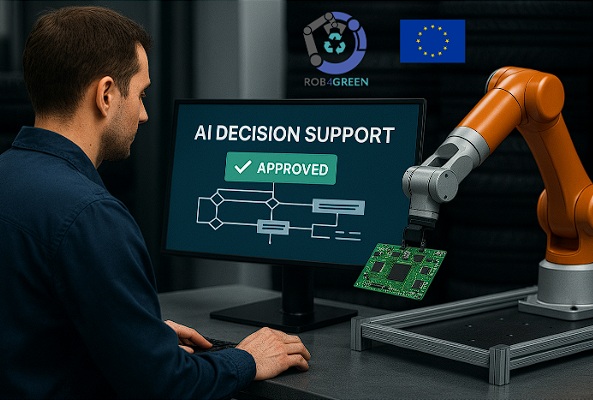
Our neuro-symbolic decision support combines logic and data to enable smarter, sustainable, and transparent manufacturing decisions.
ROB4GREEN’s neurosymbolic decision-support system is based on PyReason, which is a state-of-the-art explainable framework for temporal annotated logic.  We use PyReason to enable transparent, adaptive decision-making. The neuro-symbolic framework integrates explicit, symbolic production decision rules with data coming from Bills of Materials (BOMs), Digital Product Passports (DPPs), computer vision algorithms, and digital twins to suggest actionable activities to humans or robots. By combining transparent, symbolic reasoning with real-world data, PyReason supports manufacturers in taking sustainable actions that optimize resources, reduce waste, and ensure compliance with environmental standards.

We leverage PyReason and neurosymbolic AI to turn opaque, manual decision-making into explicit, scalable, and auditable workflows. The foundation is data alignment via an ontology that harmonizes heterogeneous sources of product data: a.o. BOMs, DPPs, and handbooks with operational procedures into a common vocabulary. Products, processes, machines, impacts, and compliance constraints are defined as interoperable concepts and relations, enabling consistent reasoning across product structures, lifecycle metadata, and shopfloor instructions.

Organization handbook rules, typically written in natural language, are transformed into formal logic (e.g., rules, constraints, and policies expressed as predicates and quantifiers). This translation makes conditions and exceptions machine-interpretable and preserves provenance for auditability. For example, “If product X contains defect Y above threshold Z, then apply process A with waste-minimizing setup B”. Our decision-support system implements these rules in PyReason and integrates predictions from the deep learning model that performs visual inspection of the product (e.g., defect detection using pattern recognition). The digital twin augments reasoning by injecting simulated constraints and outcomes. These simulation-derived constraints refine the decision space, ensuring recommended actions meet sustainability targets and operational limits.

Finally, decisions are routed to a task planner that sequences actions into an executable plan: scheduling inspections, setup changes, or process adjustments, coordinated human and robotic workforce capacity. The result is a closed-loop pipeline: aligned data → formalized rules → simulation-aware reasoning → sequenced actions.
ROB4GREEN’s decision support module turns complex decisions into sustainable wins—boosting efficiency, reducing waste, and powering a green future.
Expected benefits include:
Efficiency: Faster, automated rule execution and simulation-informed planning reduce rework and downtime.
Transparency: Explicit logic, ontologies, and provenance make decisions traceable and auditable.
Reduced Training Time: Employees are supported by guided, system-generated actions mastering the vast expertise from extensive manuals.
Precision: Neurosymbolic reasoning plus digital twin constraints handle complex tradeoffs with consistent, high-quality decisions aligned to sustainability objectives

Michael van Bekkum, AI Researcher, TNO
Michael van Bekkum is a senior scientist with the Data Science department at TNO, specializing in researching reliable, trustworthy AI systems. He holds a master's degree from the Electrotechnical Engineering department of the University of Twente. He is currently a lead scientist for TNO on AI in the manufacturing domain with a special interest in Re-X strategies and implementations. His research focuses on knowledge representation, reasoning, and neuro-symbolic systems and he has a keen interest in biologically inspired cognitive models of computation. He is passionate about putting science into practice and contributing to societal innovation with AI tools that augment human capabilities.