
How AI, Predictive Modeling and Advanced Segregation Drive Wind Industry Circularity
Thermal recycling through pyrolysis and gasification currently represents one of the most viable pathways to process the vast amount of End-of-Life (EoL) composite waste decommissioned globally. Structural composites like CFRP and GFRP, offer valuable fibre recovery and energy valorisation. However, industry adoption remains limited due to high costs, fibre degradation, char formation, and inconsistent feedstock quality.

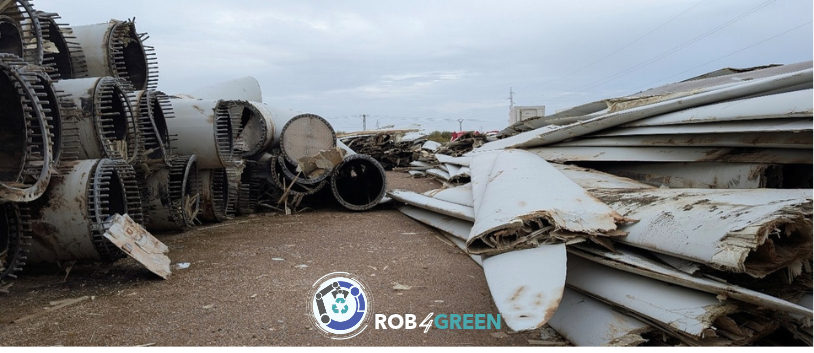
The biggest gap remains its economic viability: recycled fibres and secondary fuels often can't compete with virgin materials without subsidies, and regulatory hurdles (e.g., classifying pyrolysis oil as waste) limit market access. Additionally, feedstock variability—from epoxy to polyester resins and mixed contaminants—complicates standardization. Moreover, decommissioning big structures like wind blades represent an added challenge since the size of the composite needs to be adapted to the feeding of the recycling process.

Rob4Green targets these challenges by integrating AI-driven process optimization and circular economy models. Its approach focuses on:
- Maximizing fibre quality to preserve structural performance.
- Maximizing byproduct valorisation to open new sources of revenue.
- Reducing energy use via optimised thermal cycles and adaptive process control.

Aiming scalability and cost-competitiveness, Rob4Green could transform composite recycling from a niche solution into a profitable industry, aligning with EU circular economy goals and corporate sustainability targets.
Overcoming cost competitiveness by reducing low-margin steps and residence time.
Rob4green optimizes composite recycling using AI-driven tool, precise cutting processes and improved thermal cycles. The initial stage, led by Tecnalia, drastically boost the bulk density and homogeneity of the composite waste input. Acciona focuses on new ways to speed up the thermal processes and reducing energy cost of the recycling process (post-delamination, matrix cracking, advanced predictive model).
Unlocking high-yield fibre recovery: Bridging the gap between raw EoL composite waste and profitable, sustainable raw materials through physical-based algorithm AI-enhanced
As the research wore on, more focus has been dedicated to the optimisation of the residence time. Monitoring a pyrolysis reactor presents unique engineering challenges; high operating temperatures, strict thermal insulation, and strict safety constraints severely restrict direct instrumentation. The thermal industry has a long history, but applying its processes to composite recycling presents entirely new and complex technical challenges:
- Low Volume to weight ratio (material introduce/weight of the processing system) is significantly lower, making it more difficult to track the process through weight variation whenever it comes to use load cell or strain gauge technologies or even using rotor current intensity…
- Material input/output flow is highly variable.
- Exothermic reactions is insufficient observation to draw conclusions based on external heat flux sensing.
- Emission sensors are difficult to implement due to the intensity of gas and gas mix released during the pyrolysis process, varying greatly from one resin to other.

Tecnalia is a key partner as its role improves significantly the quality and density of the input, avoiding contamination inside the inert oven, enhancing the control we have on the thermal process and the byproduct that can be achieved from the fibre/resin separation.

In Acciona’s laboratories, the focus has been placed on the construction of predictive model (developed using Python language) using the fundamental partial derivative equations of thermal equilibrium coupled with chemical reactions. Of course, the model is extensively based and calibrated on fibre/resin ratio, density, material composition, TGA (Thermogravimetric Analysis), DSC (Differential Scanning Calorimetry). Each resin has demonstrated very distinct behaviour, asking for prior analysis before carrying out the pyrolysis process. All that information is crucial as it provides:
- Guideline regarding the residence time for pyrolysis (in nitrogen atmosphere) and for gasification (in controlled N2/O2 atmosphere)
- Prediction regarding the expected fibre quality
- Building database and knowledge by providing scientific arguments and quantitative values when comparing trials

As previously mentioned, the material input has a high variability due to inconsistent shape, thickness, site of recovery, material composition, lack of DDP, etc… However, efforts need to be done building high-reliability external boundary measurements (inlet feed, external skin, accurate mass input, downstream off-gas composition). Based on an adaptative feedforward architecture, the advanced predictive model acts as a Digital Twin accurately forecast the thermal dynamics and expected output leading to significant benefits: energy saving, production ramp up, material quality.

Nonetheless, Acciona is studying in parallel mechanical technics to apply Controlled Delamination Matrix leaving minor fibre impact, improving greatly the air and nitrogen penetration inside the thickest laminates (~50mm). Hence, residence times is reduced as it bypasses the square-law thickness diffusion barrier.

All those methods eventually would lead Europe and its wind industry on the path to sustainable and profitable circularity.
Through the synergy of Tecnalia’s high-precision pre-segregation and Acciona’s physics-informed predictive Python modeling, the Rob4Green initiative optimizes reactor residence times, slashes thermal energy overhead, and paves a scalable, data-driven pathway for Europe’s wind and composite industries to achieve true circularity.

Kévin Ducournau
Aerospace Structural Engineer with a postgraduate degree in Renewable Energy, Responsible for the thermochemical process improvement of wind blades
Originating from the Aerospace industry, Kévin Ducournau has a strong background in structural analysis, especially involving composite material. In the past, he helped the wind energy sector by developing new wind turbine blades, now he’s dedicating his energy to facilitate their decommission and reintegration.