
Don’t Shred It, REVIVE It: Teaching Robots to Harvest Value from End-of-Life E-Mobility
Europe is falling in love with light electric mobility — and its recycling system is not ready for the breakup. The European e-scooter market is projected to reach USD 60.6 billion by 2030, yet shared-fleet devices often last barely two years. A wave of end-of-life e-scooters and hoverboards is already arriving at European recycling facilities, and the infrastructure to treat them intelligently simply does not exist.
Today, these devices face one of two fates. Manual dismantling is flexible but slow, hazardous and inconsistent — workers handle damaged casings and potentially unstable lithium-ion batteries by hand. Shredding is fast but destructive: an intact e-scooter motor suitable for refurbishment can be worth €20–50, while the same motor yields less than €5 as scrap. Meanwhile, the EU’s WEEE collection rate fell to 40.6% in 2022, and regulation is tightening — the Battery Regulation (EU) 2023/1542 demands stronger recovery of waste batteries, and the Critical Raw Materials Act expects EU recycling to cover 25% of strategic raw material consumption by 2030. The gap is flexible automation: systems that can identify, assess and selectively harvest components from diverse, partially degraded devices never designed for disassembly. This is exactly the challenge ROB4GREEN Open Call 1 (Challenge C#3: AI, Data and Robotics for Parts Harvesting) set out — and the one REVIVE answers.
What if a recycling line could decide, device by device, which parts deserve a second life?
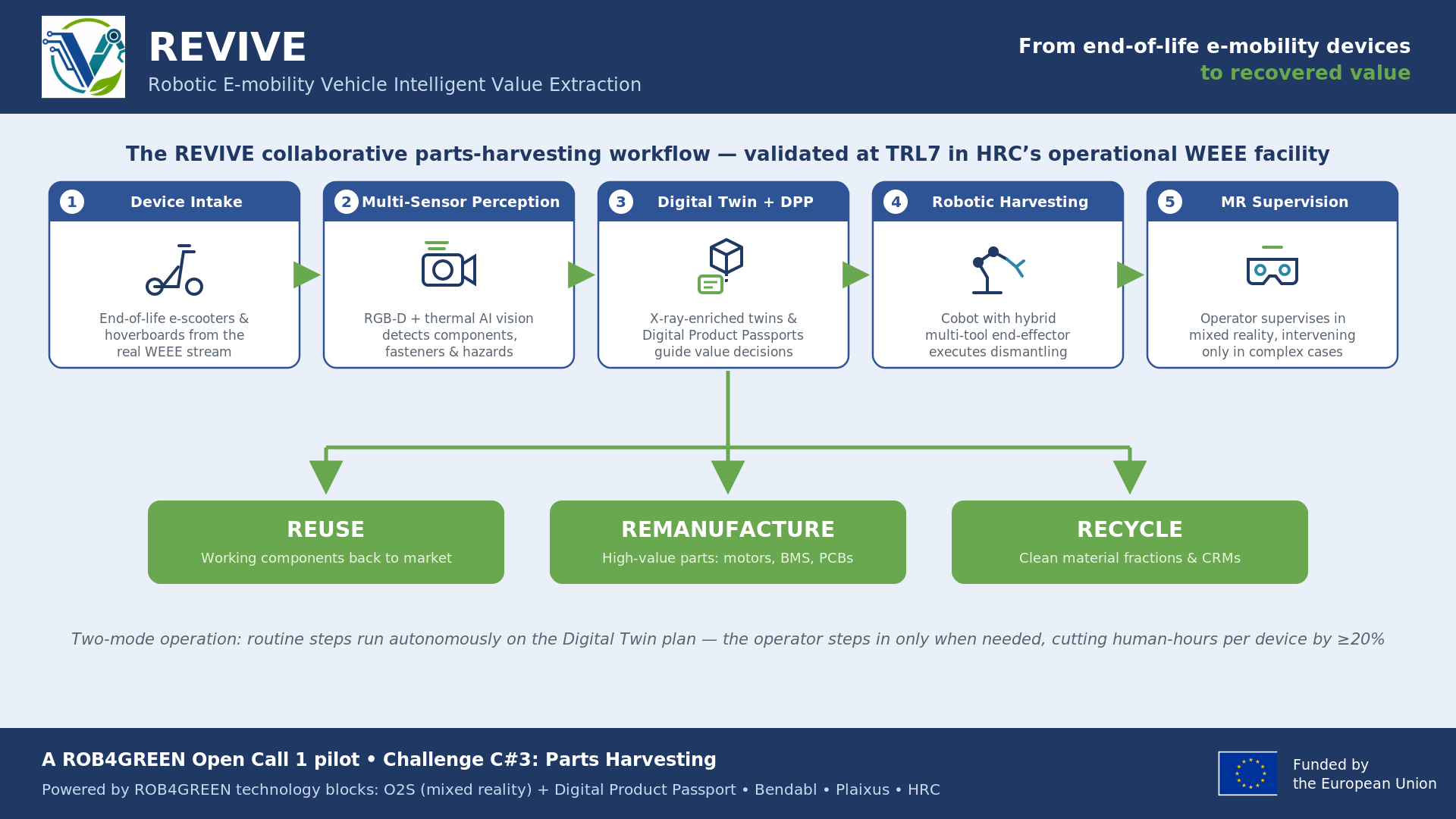
REVIVE develops a collaborative robotic workstation for selective parts harvesting from end-of-life light e-mobility devices. It combines RGB-D and thermal perception, X-ray-enriched Digital Twins, Digital Product Passports, a hybrid multi-tool robotic end-effector and mixed-reality supervision — one industrial workflow, validated at TRL7 at HRC’s operational WEEE facility in Greece.
Four tightly coupled layers — perception, knowledge, manipulation and human oversight — turn a pile of dead e-scooters into a stream of reusable motors, batteries and electronics.
The perception layer pairs RGB-D cameras with thermal imaging, running AI inference on edge hardware to detect screws, cables, housings, PCBs and battery-related components under realistic conditions: clutter, damaged housings, variable lighting and partial occlusion. Thermal sensing adds a safety dimension, flagging battery-related anomalies before and during dismantling. Manipulation is handled by a collaborative robot arm carrying a hybrid multi-tool end-effector that switches between gripping, suction, screwdriving, pneumatic impact and cutting — because the same device can contain both fragile electronics to preserve and seized enclosures that demand force. Control runs over a ROS2 backbone with force/torque feedback to adapt to seized fasteners and damaged housings.
What makes the workflow intelligent is its knowledge layer. During Phase 1, reference units are scanned with a photon-counting dual-energy X-ray system, capturing battery cell boundaries, motor windings, hidden fasteners and PCB placement that no surface sensor can resolve. These internal maps are fused with high-resolution 3D scans into Digital Twins that guide localization and access planning at every workstation. Each processed model also receives a Digital Product Passport entry in JSON-LD, linking material composition, hazard flags and component-level value to downstream routing, aligned with Regulation (EU) 2024/1781.
Operators stay in command through ROB4GREEN’s O2S block, which REVIVE extends into full mixed-reality supervision. Routine steps run autonomously on the Digital Twin plan; the operator intervenes — supported by contextual overlays of product structure, planned actions and system state — only for damaged, uncertain or safety-critical cases. Every intervention is recorded, building a structured teleoperation dataset for future robot skill learning.
The targets are concrete: over 90% component identification accuracy across at least three device models, at least 20% fewer human-hours per device, and validation with real waste-stream devices and at least five operators — recovering value, reducing hazardous manual work and feeding cleaner material streams toward reuse, remanufacturing and recycling.
By month ten: a TRL7 robotic harvesting workstation operating in one of Southern Europe’s largest WEEE facilities — turning yesterday’s e-scooters into tomorrow’s components.

Mike Karamousadakis, Plaixus CEO
Mike Karamousadakis, Plaixus, technical lead of the REVIVE AI and software track. Co-Founder and CEO of Plaixus (MEng Electrical & Computer Engineering) with over seven years of experience in industrial machine-learning pipelines, edge AI deployment and semantic data integration across eight EU-funded R&D projects. In REVIVE he leads the multi-sensor vision pipeline, Digital Twin construction and Digital Product Passport integration.