

AGRI-SORT: From seeing waste to intelligent sorting
Traditional municipal waste sorting relies heavily on manual labour combined with established mechanical separation technologies, such as magnetic drums and ballistic separators. In recent years, high-capacity NIR/VIS optical sorting systems have become widely used for the automated separation of plastic fractions. However, while these systems are highly effective for processing large volumes of relatively homogeneous material streams, they face limitations when dealing with complex and highly heterogeneous waste, where items can overlap or contain mixed material compositions.
The challenge is even more relevant when individual items need to be identified and separated based on their specific material characteristics rather than simply by broad waste categories. In practice, a single waste stream can contain different types of plastics, packaging and other materials in varying shapes, sizes and conditions. Their position on the conveyor can also change continuously, making reliable identification and separation more demanding.
Manual sorting may still be required as a secondary step, but it is slow, labour-intensive and can expose workers to hazardous conditions. To meet increasingly demanding circular economy targets, modern waste processing facilities need more flexible and automated solutions capable of making precise sorting decisions directly on moving conveyor lines. This creates a need for systems that can combine detailed material recognition with fast robotic handling at the individual-item level.
What if a sorting system could identify individual materials and decide how each item should be handled?
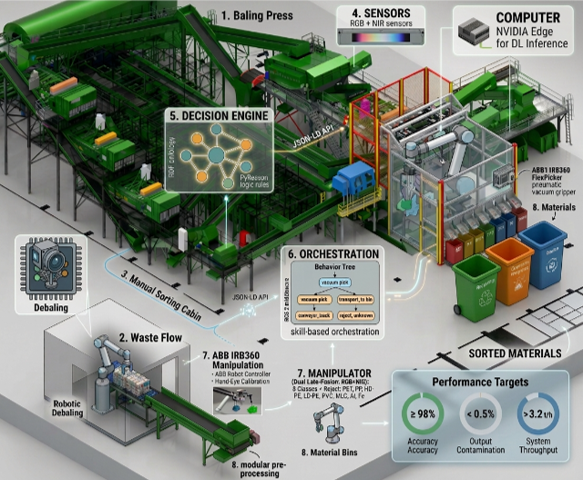
The proposed AGRI-SORT solution combines RGB and near-infrared imaging with AI-based neural networks and robotic automation. The system analyses materials presented to the robotic cell, identifies different material types and determines the appropriate sorting action. A delta robot then performs fast pick-and-place operations to separate the identified items.
Combining machine vision, artificial intelligence and robotics allows the proposed solution to connect material recognition directly with physical sorting action.
At the core of the proposed solution is the integration of high-performance optical sensing, edge computing and advanced robotics within a unified sorting cell. The perception layer combines high-resolution RGB and near-infrared (NIR) imaging to continuously capture spatial and spectral data from materials moving along the conveyor. RGB vision provides geometrical and visual features, while NIR imaging helps identify specific polymer signatures and distinguish between visually similar materials in mixed waste streams.
The captured optical data is processed in real time using specialized deep learning neural networks running on industrial NVIDIA Edge hardware installed directly within the cell. Processing the data locally avoids cloud latency and allows the system to generate object classifications and bounding boxes in real time. The identification data is then passed to a symbolic PyReason decision engine, which applies predefined sorting logic and material priorities to determine whether an item should be recovered or rejected.
System-level control and coordination of the individual components are handled through a skill-based ROS 2 orchestration architecture using behavior trees. The ROS 2 framework synchronizes the conveyor feed, vision timestamps and spatial tracking to calculate the required dynamic pick coordinates. These coordinates are then transmitted via JSON-LD APIs to the dedicated robot controller.
The physical separation of materials is carried out by high-speed delta robot equipped with a pneumatic vacuum gripper. The robot performs high-speed pick-and-place movements, removing selected recyclables from the material flow and placing them into dedicated collection bins alongside the line.
By integrating multispectral sensing, edge-based neural inference and ROS 2 robotic orchestration, the proposed solution links material identification directly to the sorting operation. This integrated approach is intended to provide the response speed, tracking accuracy and flexibility needed for continuous item-level sorting in an industrial environment.
The AGRI-SORT project aims to demonstrate how AI-driven perception and robotic action can work together to make recyclable material sorting more flexible and intelligent.

Robert Sicak – VUMZ SK, s.r.o. | Head of Research Department
Robert Sicak has several years of experience in developing AI-based technologies for recycling and automated material sorting. His expertise includes machine vision, hyperspectral imaging, neural networks and robotic automation, with a focus on improving the efficiency and accuracy of plastic identification and sorting. In AGRI-SORT, he applies this experience to the development of intelligent robotic solutions for automated recyclable material sorting.