
Die Another Day: Robotics and AI for Longer-Lived Heavy Stamping Dies
Heavy stamping dies are among the most valuable tooling assets in metal-forming production. Made from high-alloy tool steels and often weighing several hundred kilograms, they embed substantial material, energy, machining and engineering effort. Yet progressive wear, thermal fatigue cracking and local edge damage can shorten their operating life and create costly production interruptions. For many European metal-forming SMEs, current repair practice still relies on manual arc welding or directed-energy deposition processes. Operators may work close to heat, metallic particulates, fumes and intense arc radiation, while the quality of the repair depends heavily on specialist skills and precise thermal control. The physical scale of the dies creates another challenge: standard robot manipulators cannot simply lift and reposition these components for flexible repair. At the same time, defect geometry changes from one die and wear cycle to another, making fixed robot programmes and rigid fixtures poorly suited to adaptive intervention. Premature die replacement therefore wastes embedded alloying elements and manufacturing investment. DAD-AGV - Die Another Day, a ROB4GREEN Open Call #1 pilot under Challenge #1, targets this gap by combining mobile robotics, AI and additive manufacturing to make industrial die repair safer, more adaptive and more circular.
What if the die moved to an intelligent repair cell instead of the repair system moving to the die?
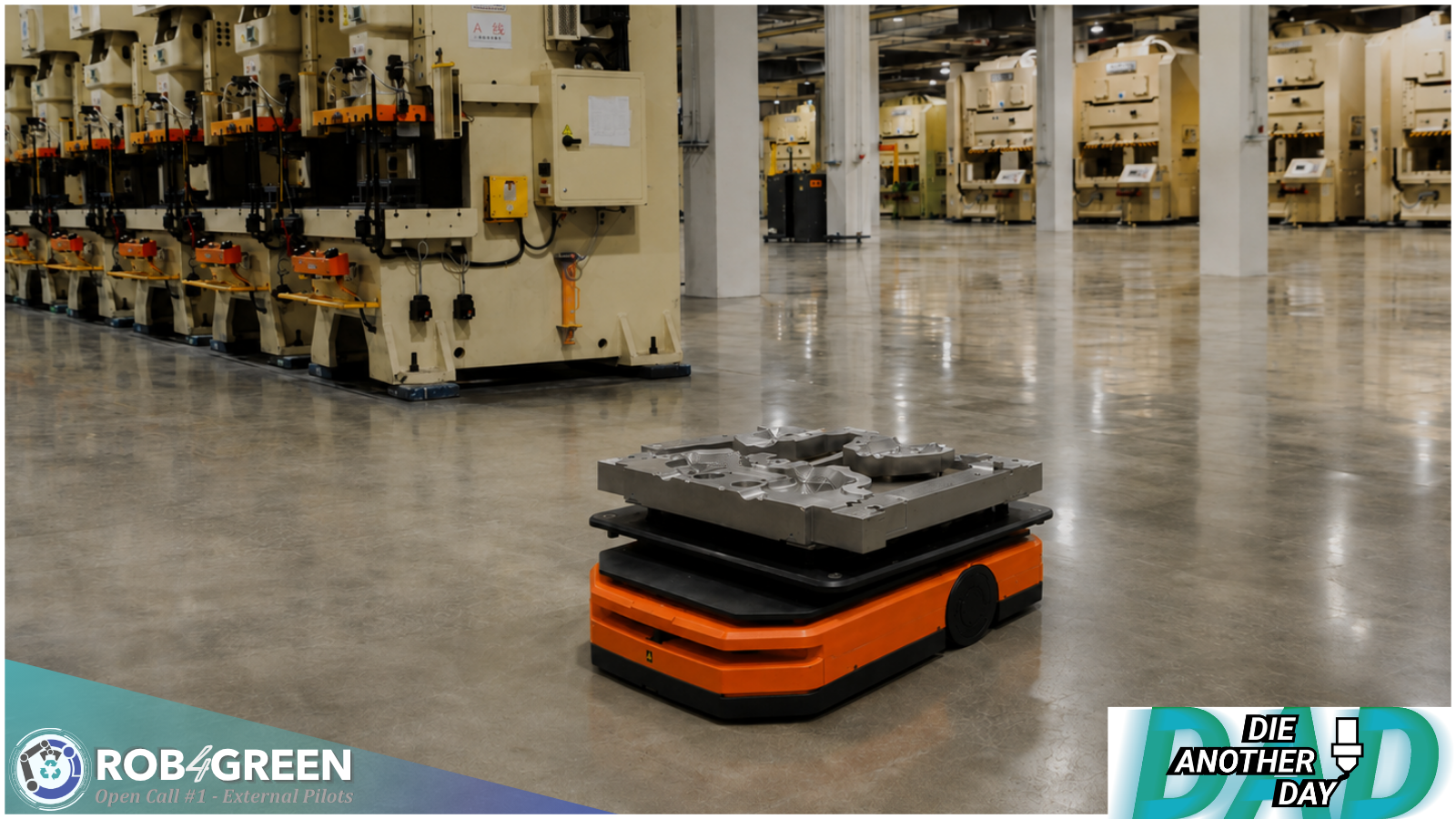
DAD-AGV uses an inverted repair geometry. A thermally managed autonomous mobile platform carries the heavy worn die to a stationary additive repair cell. After docking, robotic scanning precisely localises the workpiece and damaged region. Automated preheating, AI-assisted planning and WAAM deposition then support a repair adapted to the actual die geometry, under human supervision.
Before a die can live another day, the robot must know exactly where to rebuild it.
The workflow starts when a worn die is loaded onto the autonomous mobile platform, which navigates the shopfloor on its own and brings the component into the repair station - without requiring a manipulator capable of lifting several hundred kilograms.
Inside the cell, the system scans the die and compares its actual geometry with the reference design. This automatically locates the damaged region and lets the process adapt to how each die is placed on the platform, rather than depending on perfect fixture alignment.
Before deposition, a collaborative robot prepares the repair zone with controlled preheating - a critical step for high-alloy tool steels - while keeping operators away from hazardous process areas. The repair is then built up layer by layer through additive deposition (WAAM), following a plan that adapts to the shape and condition of each individual die.
Human expertise remains in the loop. An AI assistant developed by WZL – RWTH Aachen University lets maintenance technicians describe observed damage and supervise the process using natural language. DAD-AGV also integrates two ROB4GREEN technology blocks: SAFE-RP for safe robot motion planning and O2S for operator-system interaction.
The integrated pilot will be validated on real worn dies at IRIS S.r.l. and aims to reach TRL 7. The expected outcomes are a substantially longer die service life, lower operator exposure to hazardous repair zones, and reduced energy and material consumption compared with full die replacement.
The expected result is a safer, smarter repair workflow that keeps valuable stamping dies in production longer while preserving their embedded industrial value.

Simone Iannucci
Simone Iannucci is Co-Founder of Olorin S.r.l. and Project Coordinator of the DAD-AGV pilot. His research centers on Physical AI, spanning across cognitive robotics, embedded systems, industrial vision and computing architecture. His current work focuses on high-speed imaging, sensor integration and robotic systems for welding and inspection. In DAD-AGV, he leads the technical integration of mobile robotics and additive repair.