

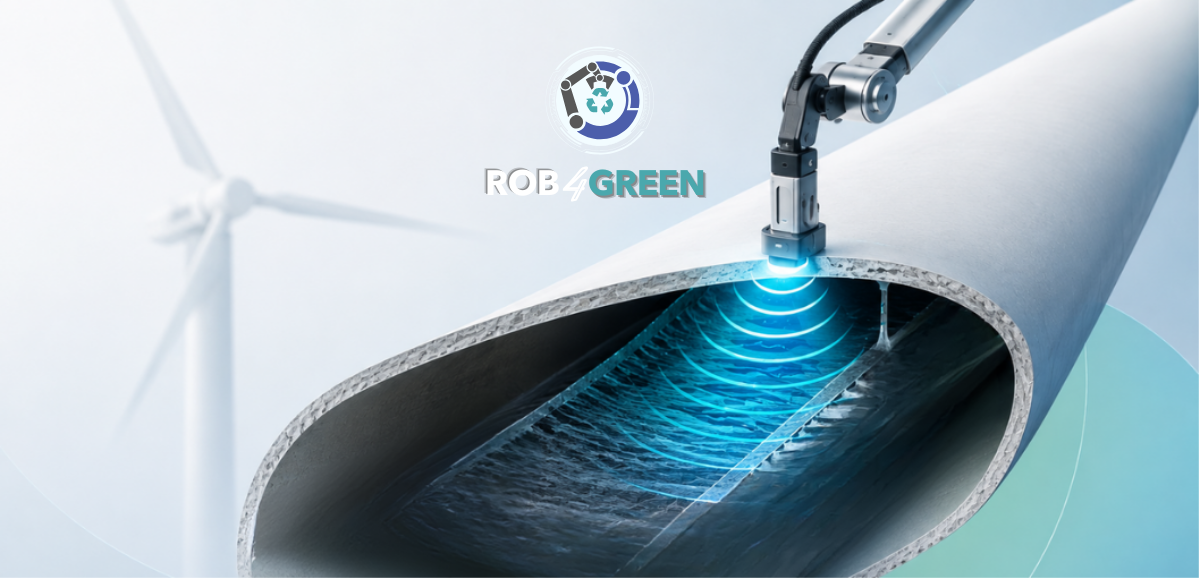
Uncovering the Inside of Wind Turbine Blades: Automated Ultrasound for Safe Robotic Decommissioning
Wind energy is a key pillar of the transition toward a circular and sustainable economy, but the automated dismantling and recycling of wind turbine blades remain a critical bottleneck. Blades are massive, heterogeneous structures made of glass and carbon fiber composites combined with resins and core materials like balsa wood or foam. Despite representing up to 16% of the total turbine weight, their complex nature limits efficient circularity. Historically, decommissioning relies heavily on manual cutting onsite before hauling to a secondary facility for shredding. This manual approach is labor-intensive, exposes workers to hazardous composite dust, and struggles with the high variability of the blades' structural composition. The challenge is further complicated because blades typically arrive at processing facilities damaged, deformed, or compacted. To enable safe and efficient robotic cutting, a precise virtual representation must be generated onsite before processing. However, because the robotic dismantling setup only permits access to one side of the structure, conventional inspection techniques fall short. Interpreting data is particularly complex due to the severe acoustic attenuation of thick composites and the unknown differences in reflected signals caused by multiple heterogeneous layers and inherent material discontinuities. Furthermore, manual inspection using coupling gel is completely unfeasible for autonomous robotic operations over large, degraded surfaces.
“How can a robotic system safely slice through massive composite structures if it cannot see what lies beneath?”
The ROB4GREEN project tackles this challenge by developing a custom, automated Pulse-Echo Ultrasonic Testing (UT) method tailored specifically for robotic integration. Transitioning away from manual gel, it introduces an automated sensor head utilizing a continuous water layer for reliable acoustic coupling over rough blade surfaces.
ROB4GREEN’s automated ultrasonic testing transforms structural uncertainty into structured data, laying the foundation for true multi-sensor AI and robotic autonomy.
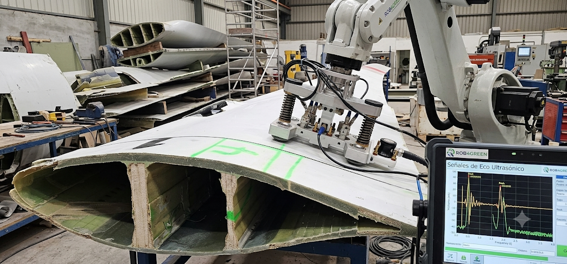
The physical prototype features a dual-plate compliant architecture designed to be mounted to the robot's end-effector flange. It uses robust compression springs to actively absorb surface irregularities and omnidirectional ball transfer units (roller wheels) to ensure low-friction displacement during continuous scanning. The core relies on optimized, high-frequency transducers (over 1 MHz) to perfectly balance deep acoustic penetration with necessary spatial resolution. By calculating precise acoustic delay lines, the system ensures that internal water reflections do not interfere with the critical echoes returning from the blade's internal layers.
Using robust signal processing—including energy-based evaluations with Tukey windows to attenuate near-field noise—the system continuously monitors acoustic energy. This achieves two primary outputs: reliably calculating the thickness of outer composite skins and classifying internal topologies into "Rich" zones (solid monolithic fiberglass) or "Poor" zones (highly attenuative balsa wood sandwich structures).
Rather than applying isolated AI directly to raw signals, ROB4GREEN formats these extracted features and feeds them into the project's generic parametric digital model. This enables a higher-level multi-sensor AI fusion strategy, combining ultrasonic structural awareness with surface data from RGBD. Ultimately, this comprehensive intelligence allows the robot to compute safe, autonomous, and material-specific cutting trajectories on the fly.
The automated water-coupled ultrasonic system enables reliable structural classification, supporting the robot to calculate precise trajectories and maximizing recovery of high-value composite materials.

Ander Dominguez-Macaya Lopez
Dr. Ander Dominguez-Macaya Lopez is a researcher in Industry and Mobility at TECNALIA, contributing to ROB4GREEN through the development and optimization of the automated ultrasonic testing system for wind turbine blade structural evaluation. His work focuses on sensor design, acoustic testing techniques, and multiphysics finite element modeling, with expertise in ultrasonic non-destructive testing, structural health monitoring (SHM), and data acquisition hardware and software