
Digital Product Passports: Using product data to inform circular processes
Over the coming years Digital Product Passports (DPPs) will become mandatory for many products being sold in the EU. It makes information available across the product’s lifecycle and thereby supports the transition to a circular economy in the EU. However there is more value to be found,beyond mere compliance. When used well, a DPP can become a practical tool for better decision-making, smarter automation and more sustainable industrial processes. By using the data collected about a product during its lifecycle we can actively inform the Re-X processes that determine its future. In other words, a passport does not only have to describe a product; it can help factories, operators and digital systems decide what can still be done with that product [1].
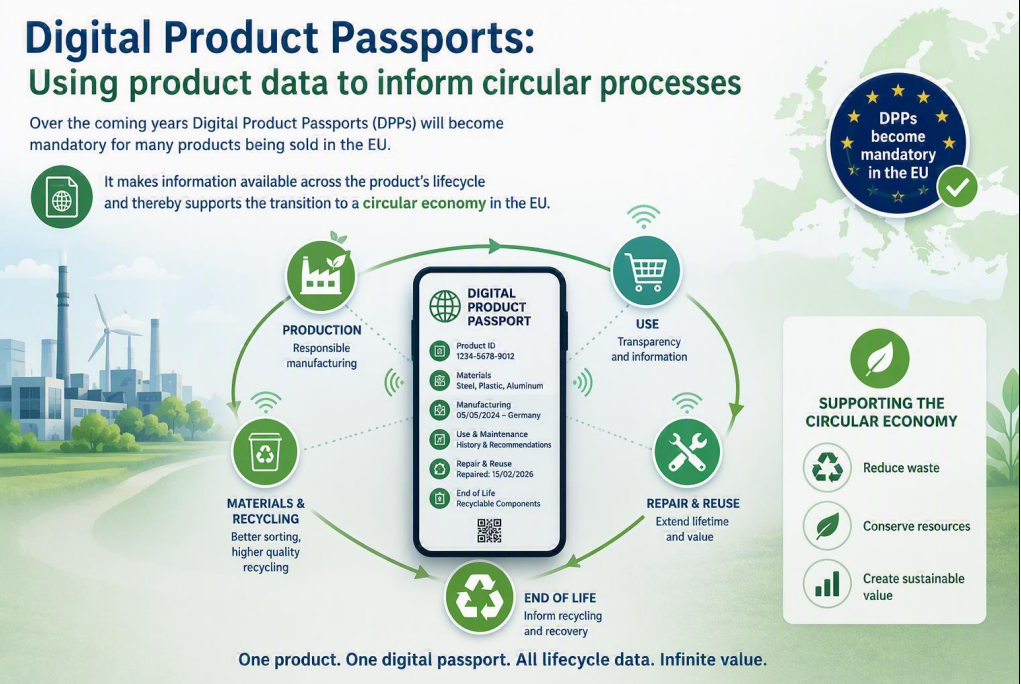
“Informing Re-X processes”
In order to introduce AI- and robotics-enabled solutions for Re-X, information is needed about the product, because the condition and history of a product are crucial to be able to make informed decisions. A robot, operator or decision-support system needs to know what product it is handling, what materials it contains, what defects were observed, which repairs were already performed and which treatment options are still feasible. When we look at the example of tire retreading, we see that a tire can be retreaded at least once. However, when there is no information about which defects were repaired in the previous retreading, it is not safe to retread the tire again, because the new repairs might interfere with the integrity of the (unknown) earlier repairs. Which means the tire will have to be scrapped. By storing this defect and repair information in the tire’s DPP, the decision to perform another retreading can be made, opening up the possibility of an entire additional lifecycle for the tire.
The key challenge: making product data useful
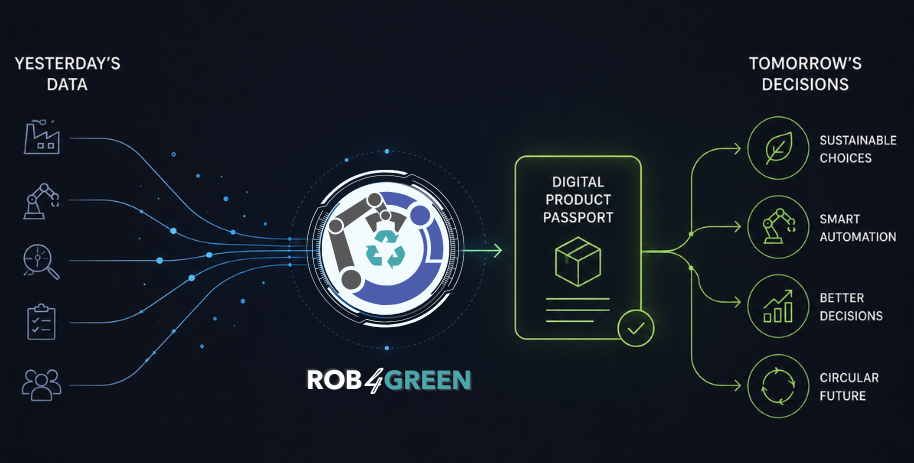
A DPP only creates value when the information inside it is understandable, trustworthy and usable by different actors and systems. This is why ROB4GREEN pays attention not only to the DPP as a data container, but also to the vocabularies, ontologies, interfaces and decision-support mechanisms that make the data actionable. For example, if one actor records a defect, another actor must be able to interpret what that defect means, how it was detected and which repair rules apply. Without shared semantics, DPPs risk becoming unreadable digital filing cabinets. With shared semantics, they can become input for reasoning, optimization and collaboration. In ROB4GREEN, this means exploring how DPP data can connect to digital twins, AI-based decision making, operator instructions and open communication architectures. The goal is not to build a passport in isolation, but to make lifecycle information part of the operational fabric of greener industrial processes. The value of DPPs is not limited to what is recorded. Its real usefulness lies in what it enables: better decisions, better collaboration and better circular processes. By allowing yesterday’s product information to inform tomorrow’s process choices, DPPs can help turn circularity from an ambition into an operational reality.
Within ROB4GREEN, Digital Product Passports are therefore more than a supporting technology.
They are a key enabler for AI-driven, data-informed and human-centered Re-X processes that can help industry move toward a greener and more circular future.


[1] Nikolova, N., van der Weerdt, R., Pietka-Danilewicz, Z., & Rongen, S. (2026). Digital Product
Passports: Where Yesterday’s Product Informs Tomorrow’s Process. Procedia Computer
Science, 277, 2155-2164.
From yesterday’s data to tomorrow’s decisions

Dr. Roderick van der Weerdt
Dr. Roderick van der Weerdt works as a Scientist Innovator at TNO. He is leading TNO’s DPP activities within the ROB4GREEN project, and is widely recognized for his contributions to the domain of DPPs within TNO.