
The cognitive demand: A new trend or more?
More than 120.000 people in Michelin Group are working in the industrial sector in 86 different locations. So, workers’ care is key in tire manufacturing (and the re-manufacturing) and that is why, for 25 years, Michelin has included ergonomics at the heart of process engineering. From the early designs of the 90’s to the last innovations of the 2020’s, integrating the workers into the machine environment is a challenge in every project (even if it is sometimes difficult and time & money consuming). A lot of elements have been integrated to master the physical work done by the operators (reducing manual loads, optimizing working benches, placing the operations in a way that the worker will not hurt himself, …). But as industry is moving forward to a more digital world, the worker is now required to have a different approach in his daily tasks, so only looking at physical ergonomics is no longer sufficient.
“Cognitive demand” is not a new trend; it is the name we now give to a longstanding but increasingly visible aspect of work that directly impacts the worker.
Every parent understands it intuitively! Imagine the machine as your child: the worker must ensure it receives the right “feeding” (incoming product) from the “grocery store” at the right time, because if not, the “baby” will cry (the process might stop). Quantities must also be correct: too little causes starvation, too much is a “throw-up” risk (underload or waste). Machine’s health (impacting the quality and tolerances of ongoing products) must be constantly monitored to avoid “illness” (producing bad products) or “sickness” (a breakdown). When that happens, the machine must be taken to the “hospital” (the maintenance “doctor” specialists) for a minute or more (it will depend on the diagnosis). And of course, the daily production targets must still be met otherwise the “partner/boss” is not happy.
With an experienced, skilled worker, this kind of care seems manageable (the cognitive demand is there, and the worker can manage the load). But today, because of high turnover, many machines are effectively cared for by a succession of “first workers”. And just as you only have one first child, many workers only have one first real experience with a complex machine; so if the cognitive demand is not well expressed, the worker can face an “overload”…
“How could we master cognitive demand in this case?”
We will do our best to explain it shortly:
To evaluate working conditions, Michelin uses an internal ergonomic assessment tool called EVANE. Traditionally, this tool was only evaluating physical and environmental constraints. As industrial environments become increasingly digitalized, Michelin decided to extend this approach to include the cognitive demand (not the trend!).
Cognitive demand evaluation is not a measure of an individual's mental workload, stress level, or capabilities because these aspects depend on personal factors such as experience, skills, or fatigue.
Instead, the objective is to evaluate the mental effort that a work situation may require because of its design and organization. This may include monitoring information, managing priorities, responding to alarms, or making decisions in real time.
In other words, we do not evaluate the person; we evaluate the cognitive demand generated by the work situation.
This is only the first step. The challenge is to include technologies in the design that help operators manage this demand more effectively.
Will ROB4GREEN help to manage the cognitive demand?
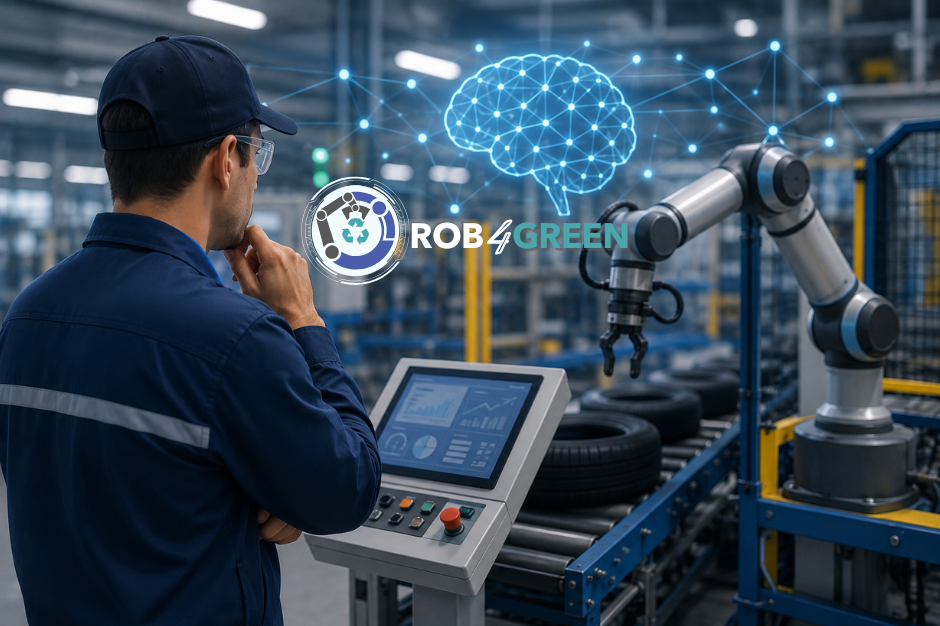
Collaborating with a robot adds new responsibilities for the worker, who must now “care for a newborn sister or brother.”[AA3.1] A collaborative robot alone will not improve the worker’s daily situation; this must be compensated by integrating AI so that the overall system better supports the human. In ROB4GREEN, a set of techno blocks will assist the worker in managing both the robot (“baby”) and their own tasks.
•AIBAD (AI based Decision Making) the friendly uncle who will support and guide workers’ decision.
•RePlan (AI-based scheduling engine) the father scale which will orchestrate the tasks between the robot and the worker to optimize and balance both workload so that there will be no complain of somebody working more than his sister…
•DIAL-V (Natural Dialogue and Voice Interaction Pipeline) and O2S (Multi-modal Operator-System Interaction Suite) the skilled grand-parents who will allow worker and robot to speak and understand each other smoothly.
•WorkGen (AI-based work instruction generation agent for Re-X operations) the older brother who read a lot of books and will be around to help worker and robot in the daily work.
Trying to predict accurately the effects of those elements might be difficult but one thing will be key: giving the worker the meaning of his work. Let’s wait for the baby robot’s birth to evaluate the whole family’s help to the human and if the worker will continue to grow in his/her working environment! ROB4GREEN have to be a support not a constraint for the worker.

Camille ECHEVERRIA PEREIRA, MICHELIN Group Ergonomist, EUR. ERG.®
Camille is a Group Ergonomist with more than 15 years of experience in improving working conditions and integrating human factors into industrial performance.

Michel CUNAT, process expert, MICHELIN.
Michel is a process expert with more than 20 years of experience in the retreading domain and with his background, Michel will support the ROB4GREEN project to make the retreading use case a success.