
Advancing Abrasive Waterjet Cutting with Cable Robotics for Wind Turbine Blade Recycling
Wind energy is a key pillar of the transition toward a circular and sustainable economy. However, composite materials used in wind turbine blades remain a major challenge, as their heterogeneous composition (combining fibres, resins, adhesives, and core materials) limits efficient recycling despite representing up to 16% of the total turbine weight.
A critical bottleneck lies in the material segregation stage, where composite-rich regions must be separated from areas containing adhesives, coatings, or foams. This process is currently manual, inefficient, and resource-intensive, and becomes even more complex because blades typically arrive at recycling facilities damaged, deformed, or compacted, making material identification and handling difficult.
In this context, cutting technology plays a key role in enabling efficient downstream processing. Conventional methods such as mechanical shears or saws are often limited by high mechanical loads, poor adaptability to irregular geometries, and lack of flexibility under real operating conditions.
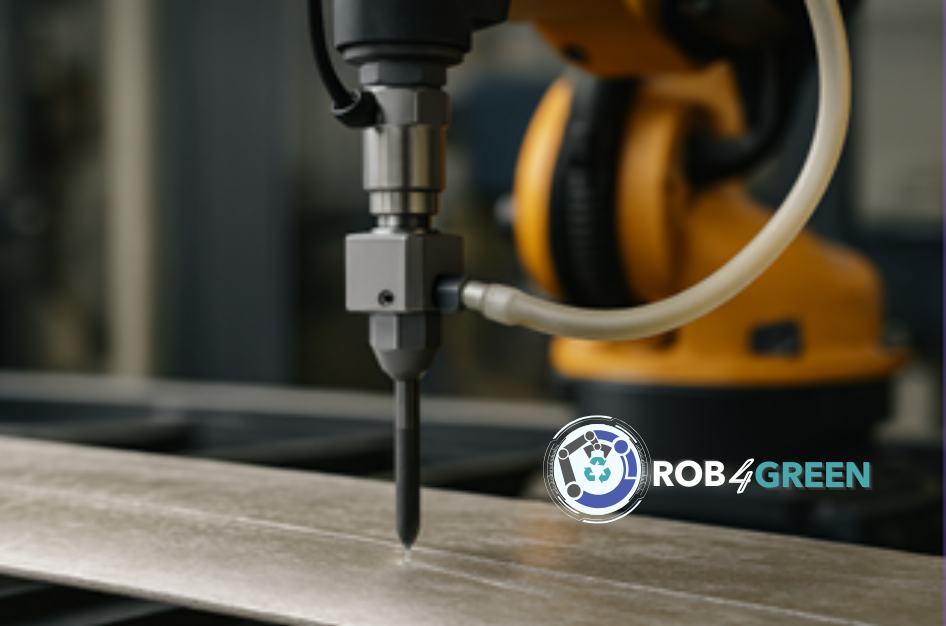
The ROB4GREEN project addresses this challenge by introducing a smart, automated cutting solution based on Abrasive Waterjet (AWJ) technology. Thanks to its cold cutting mechanism, low interaction forces, and ability to process complex composite materials, AWJ enables robust and selective cutting even under degraded conditions.
To fully exploit these capabilities at large scale, AWJ will be integrated into a cable-driven robotic system (Cranebot), allowing adaptive and automated cutting along the entire blade. This combination will significantly reduce the need for downstream segregation while improving efficiency and scalability.
“How can we efficiently separate composite materials in damaged wind turbine blades?”
Abrasive Waterjet (AWJ) cutting uses ultra-high-pressure water mixed with abrasive particles to efficiently process composite materials. In ROB4GREEN, this technology will be integrated into a cable-driven robotic system, enabling selective cutting to separate composite-rich regions from areas containing adhesives, foams, or coatings. This approach will facilitate efficient large-scale processing of complex composite structures while minimizing downstream segregation requirements.
For the first time, waterjet cutting will be combined with cable robotics to access entire blades and selectively separate composite-rich blade regions, reducing downstream segregation needs.
Abrasive Waterjet (AWJ) technology is particularly well suited for processing wind turbine blades due to its cold cutting mechanism, low mechanical loads, and high adaptability to composite materials. Unlike conventional cutting processes, AWJ does not generate heat-affected zones or significant tool forces, making it ideal for cutting heterogeneous and layered composite structures without inducing additional damage.
This is especially relevant in real recycling scenarios, where blades are typically degraded, deformed, or compacted during dismantling and transport. Under these conditions, AWJ offers a major advantage, as it can reliably cut through variable thicknesses and material configurations without requiring precise fixturing or uniform geometry.
However, a key limitation of AWJ in large-scale applications has been the restricted workspace of conventional robotic or gantry systems. To address this challenge, TECNALIA will integrate AWJ cutting into a Cranebot cable-driven robotic system within ROB4GREEN, enabling:

•Full blade accessibility, covering large structures with a single system
•Flexible positioning of the cutting head, even in irregular or constrained setups
•Adaptability to real conditions, including damaged and non-uniform blades

The Cranebot can be combined with a robotic manipulator to provide local dexterity and accurate tool orientation, creating a hybrid solution that combines large-scale reach with precise control.
In addition, the system will incorporate advanced sensing and AI-based modelling, including 3D scanning, RGBD vision, NIR sensing, and AI-supported ultrasound. These technologies will allow identification of composite-rich regions, enabling selective cutting before shredding.
By leveraging the intrinsic advantages of AWJ and combining them with robotics and AI, the system will provide a robust, flexible, and scalable solution for wind turbine blade dismantling, improving efficiency and enabling more effective recycling.
AWJ’s adaptability to composite materials and degraded structures will enable efficient and selective cutting, supporting the separation of high-value composite regions in wind turbine blades.

Amaia Alberdi Gurrutxaga
Dr.-Ing. Amaia Alberdi Gurrutxaga is a researcher in advanced manufacturing processes at TECNALIA, contributing to ROB4GREEN through the development and optimisation of Abrasive Waterjet (AWJ) cutting for wind turbine blade dismantling. Her work focuses on material removal technologies, process modelling, and data-driven analysis, with expertise in waterjet machining, hybrid processes, and advanced manufacturing systems.