
4.0 Industry Wind Blade Decommissioning
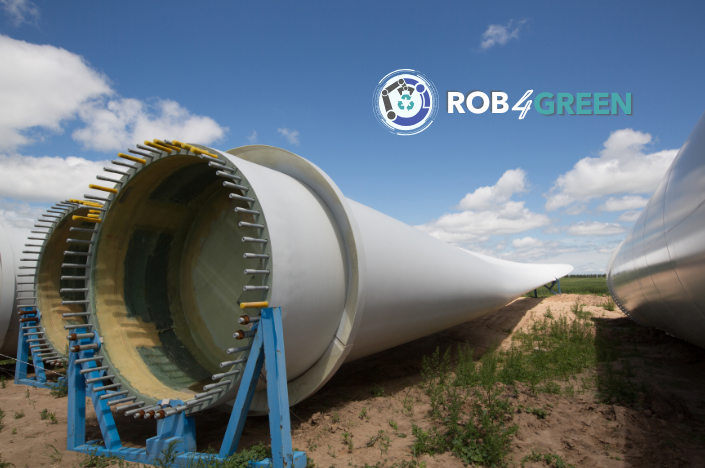
The wind energy sector faces a looming “composite crisis”. While wind turbines are icons of green energy, their blades—massive structures made of complex glass and carbon fibre composites—have historically been difficult to recycle. Current industry practices rely heavily on manual decommissioning. Wind blades are often cut onsite using handheld saws or massive hydraulic shears before being hauled to a secondary facility for further shredding.

This status quo is fraught with inefficiencies. Manual cutting is labour-intensive, exposes workers to hazardous composite dust, and lacks the precision needed to preserve fibre quality for high-value reuse. Furthermore, the internal geometry of a blade, specifically the shear webs, makes uniform crushing and compacting a logistical nightmare. Rob4Green tackles a clear industry gap: a smart, scalable, and automated solution that can bridge the distance between a "retired" blade and high-purity raw material removing the tedious and dangerous manual labour workforce. For that purpose, Rob4Green will deploy intelligent robotics, transforming decommissioning from a waste-management headache into a precise, circular manufacturing process.

Acciona has developed a pioneering pyrolysis-based approach to recycle composite materials. Through a thermochemical process, the polymer matrix can be broken down, allowing the products resulting from the decomposition to be condensed and later reused in the chemical industry. Additionally, the process can recover the glass or carbon fibres from the composite material. These fibres are then treated for their future incorporation into the market in the form of short fibre reinforcements. The versatility of this method makes it particularly effective for the sustainable management of end-of-life wind turbines blades. In this context, the ROB4GREEN project presents a solution for an automated preparation and dismantling of the wind blades. By optimizing this pre-recycling phase, the materials are better conditioned for the pyrolysis treatment, maximizing product quality and industrial efficiency.

“Can robotics turn the blade graveyard into a sustainable resource mine for the future of green manufacturing?”
Rob4Green is an automated robotic decommissioning platform that uses AI-driven computer vision to dismantle wind blades. By integrating autonomous cutting and crushing modules, the system optimizes the entire workflow—from onsite dismantling to final segregation—ensuring maximum material recovery and worker safety through a fully automated, digitalized process.
Rob4Green’s AI-based digital twin delivers precise and automated cutting paths, optimizing material recovery and ensuring worker safety in the most demanding environments.
Rob4Green revolutionizes the steps outlined in the recycling workflow by introducing an autonomous robotic ecosystem. The system utilizes a suite of sensors, including 3D sensor for blade scanning, high-resolution RGB-D cameras to provide depth and perspective and ultrasound sensors, to perform a structural scan of the wind blade. These sensors identify key internal features, such as the spar caps and shear webs, which are critical for Step 2 (crushing) and Step 4 (precision cutting).
At the heart of the system is a Digital Twin framework where the AI generates a virtual model of the specific blade model. This allows the path-planning algorithms to calculate the most efficient cutting trajectory, minimizing energy consumption and maximize the wind blade raw material recyclability. The robotic setup features a heavy-duty multi-axis arm equipped with specialized end-effectors designed to suppress dust while slicing through fibre reinforced  polymers.
By integrating this automation into the workflow, Rob4Green eliminates the need for human operators to work near fibre-glass dust and high-tension components. The precision of robotic shredding and segregation ensures that the resulting 50mm composite pieces are uniform and free from contaminants. This higher-quality output directly improves the economic viability of the recycling process, turning what was once landfill-bound waste into valuable feedstock for the construction and automotive industries.
Rob4green fosters a cutting-edge blade segmentation by reducing human exposition while improving the recycling efficiency.